

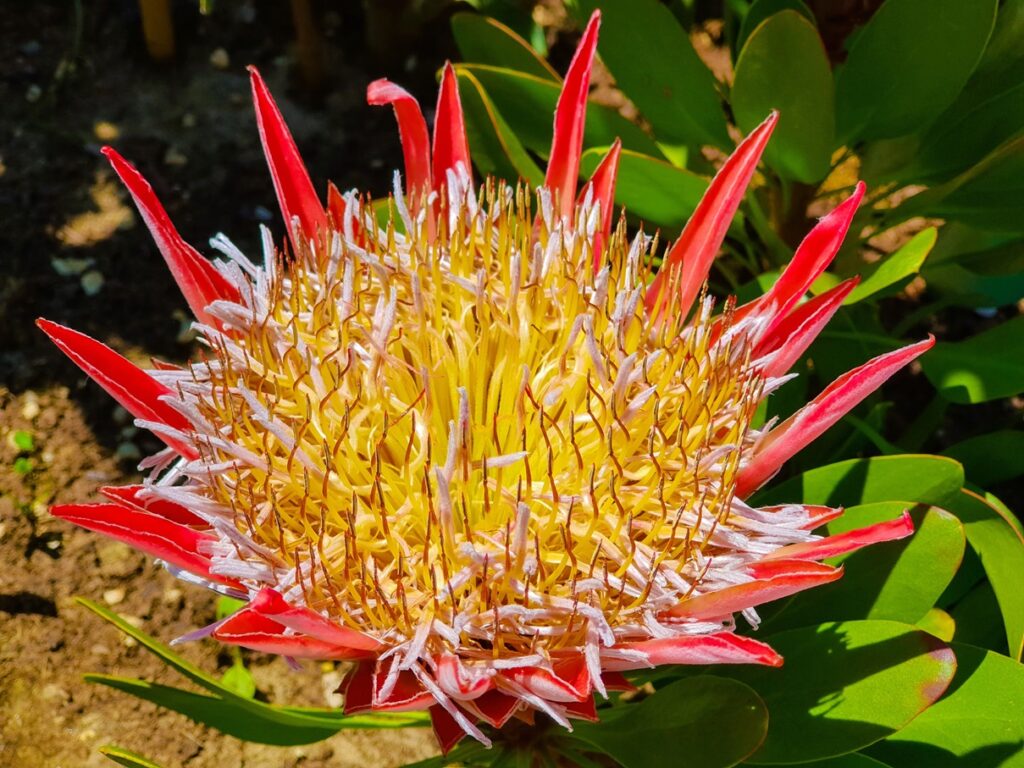
Resources and Guides for learning more about Proteas
For many South Africans, the King Protea is instantly recognisable. It is our national flower, appears on our currency and national documents, and has even given our national cricket team its name. But the King Protea is only one member of an extraordinary botanical family – and once you start exploring the world of proteas, it is difficult not to become fascinated.
That is one of the reasons behind our Protea Emoji Campaign. We want proteas to have a tiny place on our keyboards, but the campaign is really about something much bigger: recognising, appreciating and learning about one of the most remarkable groups of plants on Earth.
So, if you would like to go beyond the familiar flower and discover the science, history, ecology, evolution and conservation stories behind proteas, here is our free Protea Learning Library.

🌿 Start here: What exactly is a protea?
The first surprise is that what we casually call a “protea flower” is often actually a flowerhead containing many individual flowers, surrounded by colourful bracts. Proteas also have some fascinating botanical features, including their distinctive pollen-presenters – specialised structures that help transfer pollen to visiting pollinators.
For a straightforward introduction, start with:
- Protea Atlas – What are the Proteas? — An excellent botanical introduction to Proteaceae, including flower structure, pollen presentation, leaves, fruits and the differences between genera. The Protea Atlas is an older resource, but remains an extraordinary repository of information.
- Notes from a Cape Town Botanist – Proteas: An Introduction — A beautifully accessible introduction covering the diversity, evolution, ecology, pollination and conservation of Protea. It is particularly useful for understanding the extraordinary range of species found across the Cape Floristic Region.
- The Table Mountain Fund – 10 Things You Might Not Know About Our Magnificent Proteas — A fun introduction packed with facts, including the origin of the name Protea, the King Protea, fire adaptations, Gondwanan history and climate change.
- Leon Kluge is an internationally acclaimed, multi-award-winning South African landscape designer, botanist, and artist known for “painting with plants”. He shares a deep, celebrated relationship with proteas, using South Africa’s iconic national flower as the focal point of his world-conquering botanical art. He acts as an unofficial global ambassador for the Cape Floral Kingdom (fynbos), using proteas to showcase South African biodiversity on the international stage. At the Chelsea Flower Show he has flown tens of thousands of fresh protea stems from Western Cape farms to London for his gold-medal display.
- The Fynbos Guy explores ancient proteas in the Cape floral kingdom, tracing their multi-million-year history, fire survival methods, and unique ecological roles alongside sugarbirds and conebushes.

🔥 Fire, snow and millions of years of evolution
Proteas become even more interesting when you look at where they live and how they survive.
Many species are adapted to fire. Some regenerate from underground structures; others depend on fire to trigger the release or germination of their seeds. And while we often associate proteas with warm, sunny mountainsides, some species live in remarkably harsh environments.
Protea cryophila, the Snow Protea, grows above 1,700 metres in the Cederberg. Other species survive at high altitude in the Swartberg, Kammanassie Mountains and Drakensberg. Some of these mountain specialists are particularly vulnerable to a warming and drying climate because there is simply less room to move upwards.
For a deeper dive:
- Botanical Society of South Africa – Greek Gods, Fire & Snow: An Introduction to Proteas — Probably one of the best free introductions available. It explores the genus’s diversity, ancient origins, fire adaptations, high-altitude species, pollination and conservation. It even takes us back to Gondwana — and fossil evidence of proteaceous plants in Antarctica.
- THURSD – Protea: Nature’s Ancient Beauty — A more accessible and visually oriented exploration of the ancient history, symbolism, appearance and cultural fascination surrounding proteas.
- Protea & Bloom – About Protea — A useful introduction to the family, including its ancient origins, cultivation and the remarkable adaptations that allow proteas to survive in nutrient-poor environments.
- New York Times — How Proteas Became a Symbol for South Africa

🐦 A flower can be an entire ecosystem
Look closely at a protea in flower and you may discover that you are looking at a miniature gathering place for wildlife.
Sunbirds and sugarbirds visit many proteas, but they are not the only visitors. Insects can be extraordinarily abundant – one protea flowerhead may attract thousands of tiny visitors. Some proteas have taken an even more unusual evolutionary route: they are pollinated by mammals.
Rodents visit some species, while research has recorded Cape Grey Mongooses and Large-spotted Genets visiting protea flowerheads. Mammal-pollinated species often have unusual characteristics, including low-growing flowerheads, strong scents and large quantities of nectar.
That means learning about proteas can quickly become a gateway into learning about pollination, insects, birds, mammals, fire ecology and the interconnectedness of fynbos.

🌡️ Proteas are also telling us about a changing climate
Proteas are deeply tied to the environments in which they evolved. That makes them indicators of environmental change – but also vulnerable to it.
Some species are already shifting their ranges as temperatures rise, while highly specialised mountain species face particularly difficult futures. Research and reporting on South African proteas increasingly points towards hotter, drier conditions and the possibility that some range-restricted species may simply run out of suitable habitat.
For another perspective:
- SA’s Iconic Protea Flower Relocates as Climate Warms — Explores how climate change is affecting proteas and how growers and scientists are responding to changing conditions.
- Proteas: A Story of Beauty and Resilience — As fires become more frequent or conditions become hotter and drier, some proteas may not have enough time to mature and reproduce before the next disturbance. In a changing climate, protecting intact fynbos and maintaining the ecological conditions that allow proteas to regenerate is increasingly important.
🔎 Go outside and become a plant detective
The best protea resource, of course, is still the one growing outside.
Take a photograph. Look at the leaves. Examine the flowerhead. Watch what visits it. Notice where it grows and what grows around it.
And then try identifying it.
- iNaturalist — Photograph plants and upload observations, compare them with other observations and learn from a worldwide community of naturalists and scientists.
- Protea Atlas — Explore species information, identification resources, distribution information, photographs and ecological information.
- YouTube – Protea flower videos — A huge collection of free videos, from identification and botanical talks to footage of proteas and their pollinators in the wild.

🌸 And then there is the conservation story
Perhaps the most important reason to learn about proteas is that not all of them are safe.
The King Protea is widespread and currently classified as “Least Concern” on South Africa’s Red List. But that is not representative of the entire genus. SANBI’s Red List currently includes six Protea taxa classified as Critically Endangered, six as Endangered and many more as Vulnerable. The list includes species such as Protea odorata, P. holosericea, P. inopina, P. namaquana, P. nubigena and P. roupelliae subsp. hamiltonii in the Critically Endangered category.
Some are threatened by habitat transformation. Others face inappropriate fire regimes, invasive species, drought, water-table changes or climate change. Some occupy incredibly small ranges.
The Red List is therefore worth bookmarking:
- SANBI Red List – Protea species — The authoritative South African source for the conservation status of individual Protea species and subspecies.
- IUCN Red List — Search the global conservation database for Proteaceae and individual species.
🌱 Learning is where conservation begins
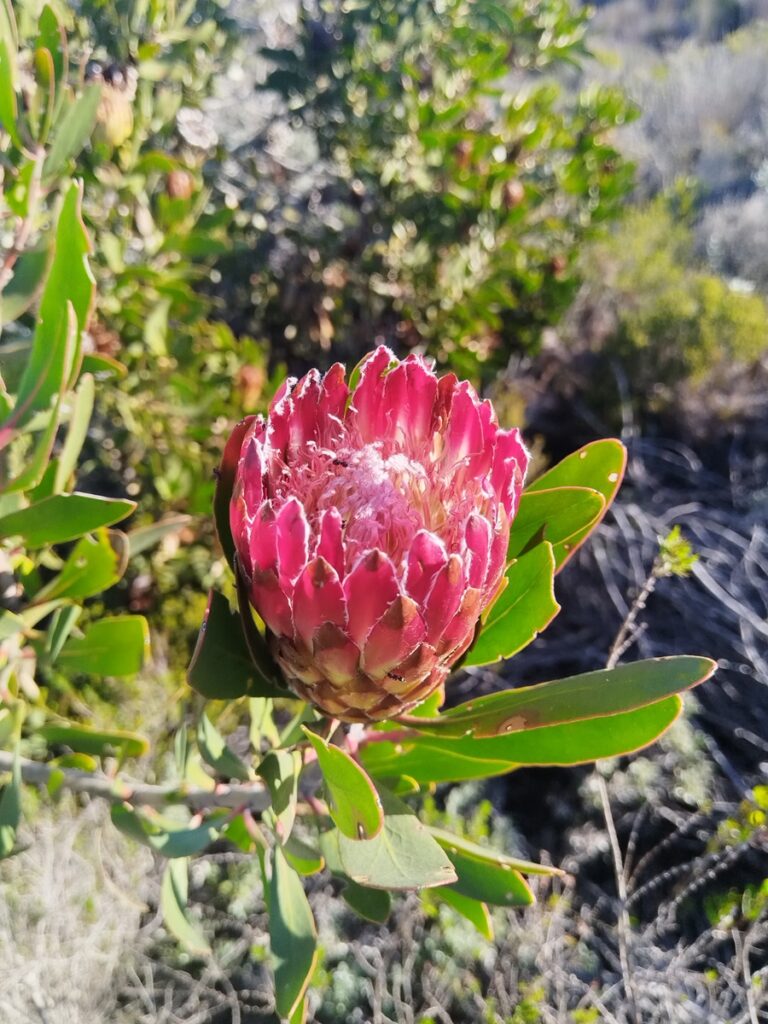
There is an irony in the fact that the protea is so familiar to South Africans – and yet there is still so much about it that most of us don’t know.
There are ancient evolutionary stories hidden in its DNA. There are fire adaptations written into its life cycle. There are intricate relationships with birds, insects and mammals. There are species living on freezing mountain peaks, species surviving in dry lowlands and species hanging on in tiny fragments of habitat.
And there are species that urgently need our attention.
That is why our Protea Emoji Campaign is about more than just having a pretty little icon on all our devices.
Yes, we believe the world’s richest floral kingdom deserves its own symbol, but we also want that symbol to spark questions:
“What is a protea — and why is it so special?”
If a protea emoji makes someone curious enough to look it up, learn its name, photograph one on a hike, discover its pollinators or find out that some species are endangered – including almost half of the officially recognised protea species in South Africa – and that these plants need and deserve our conservation efforts – then that tiny symbol has already done something worthwhile.
So explore. Learn. Get outside. Look closely. And fall in love with proteas – because it is much more appealing to protect something once you understand how extraordinary it is. If you have any preferences on what a protea emoji should look like – tell us your favourite here. 🌸🌿 #EmojiForProtea #CapeFloralKingdom #ProudlyFynbos