

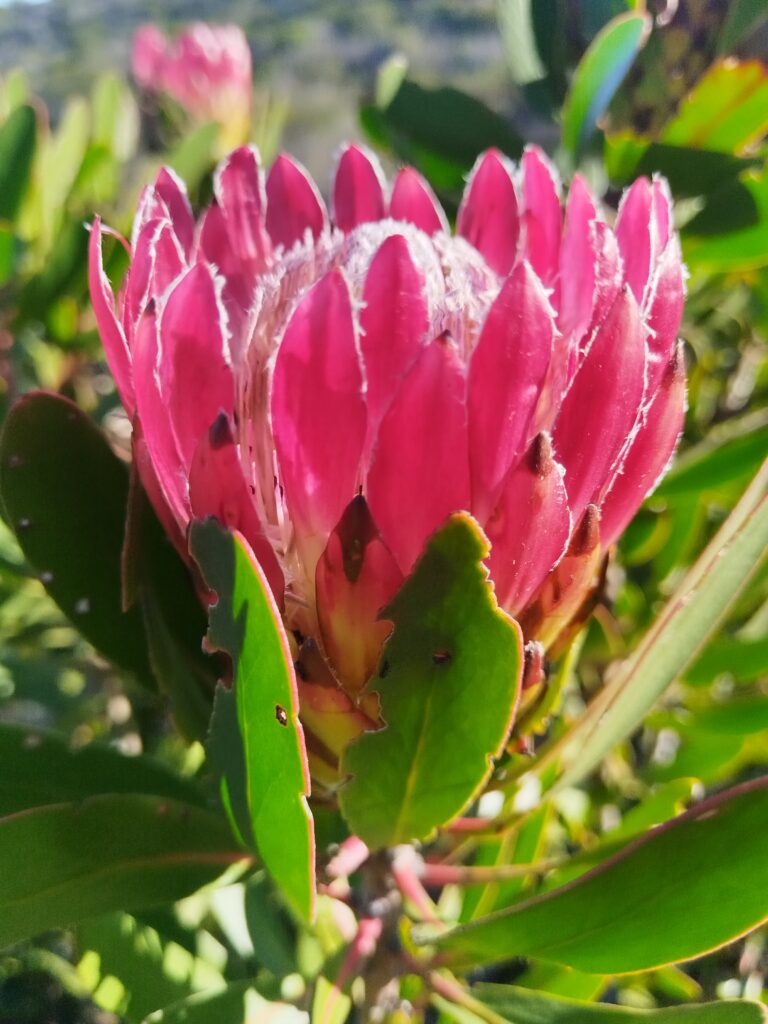
Look at a protea and you see a flower. Look closer, and you see an ecosystem.
There are flowers we admire because they are beautiful, and there are flowers we admire because – once we understand them – we realise just how extraordinary they are. There are flowers that are useful. There are flowers that are culturally and nationally important, historically significant, paleontological salient, economically valuable, ecologically essential, and flowers that are instantly recognisable and majestic. Proteas – the flower that holds a world – belong to all these categories.
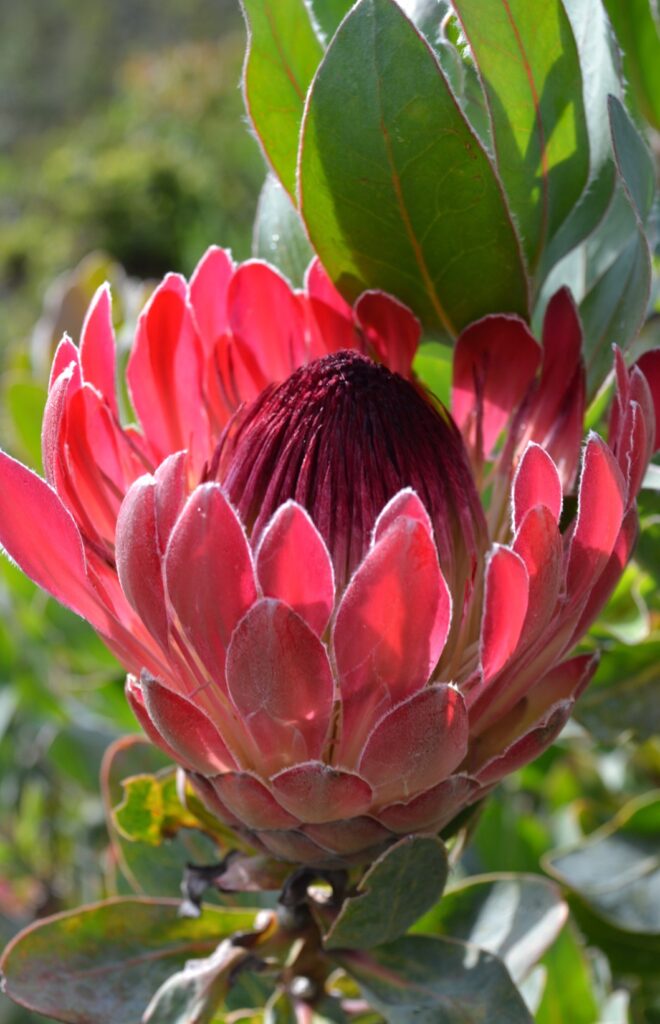
Beauty is not the opposite of survival: sometimes, beauty and survival intersect. Look closely enough at a protea and the boundary between flower and artwork begins to disappear. Its stately flower heads can be enormous, delicate, architectural and almost otherworldly. Some appear to be made from velvet; others from feathers, scales or flames. Their kaleidoscopic colours range from soft creams and greens to pinks, reds and deep burgundies. Their forms seem to belong simultaneously to the worlds of botany, sculpture, imagination and the supernatural. The protea is beautiful because of its evolutionary history, its adaptations and its resilience – not in spite of them.
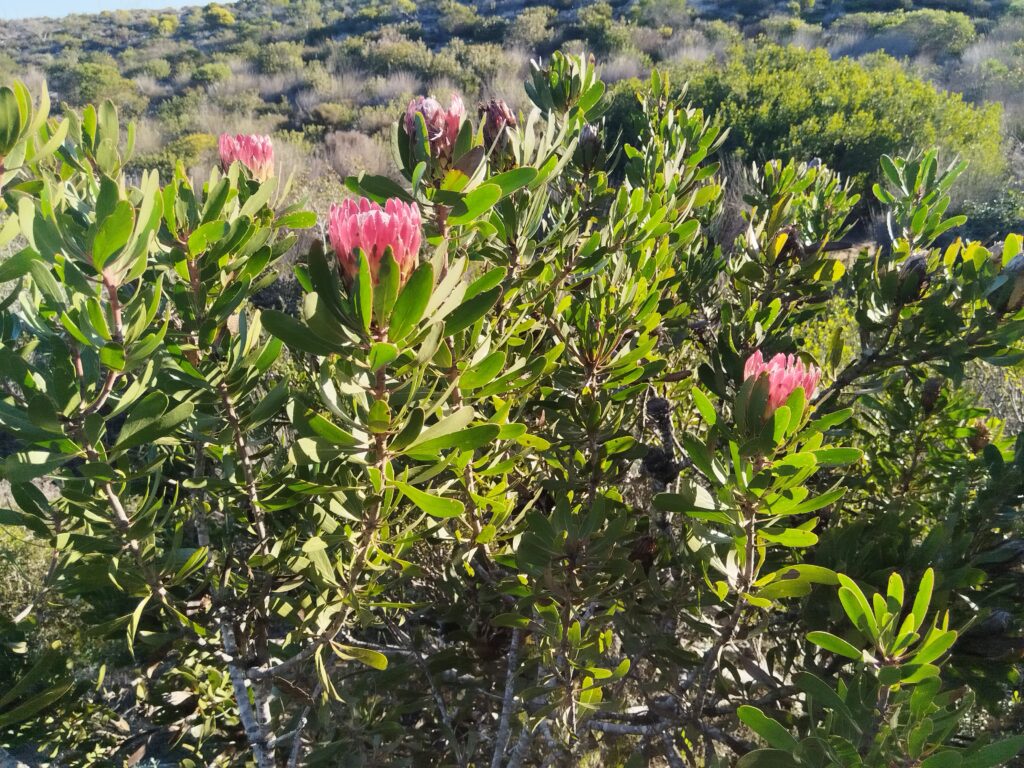
In nature, fractal-like patterns can be seen in branching trees, certain leaves, some fruits and vegetables, river systems, the intricate networks of veins within leaves, and even in snowflakes – where similar shapes or structures repeat at different scales. Proteas can display fractal-like qualities through their repeated patterns and intricate structures. Proteas aren’t true mathematical fractals, though their structures are perceptibly analogous. A flower head contains many flowers, while the plant’s branching and growth patterns create other forms of natural repetition. Proteas reward every level of attention. From far away they’re exquisite. Closer up, they’re fascinating. Closer still, they become remarkable. The patterns of nature do not stop at the edge of a flower. Nature rarely creates beauty in a single stroke: it builds it through repetition, variation and connection. Challenging our simplistic expectations of what a flower should look like, this may also explain why proteas have such a strong presence in human culture. We are naturally drawn to patterns, symmetry, colour and complexity.
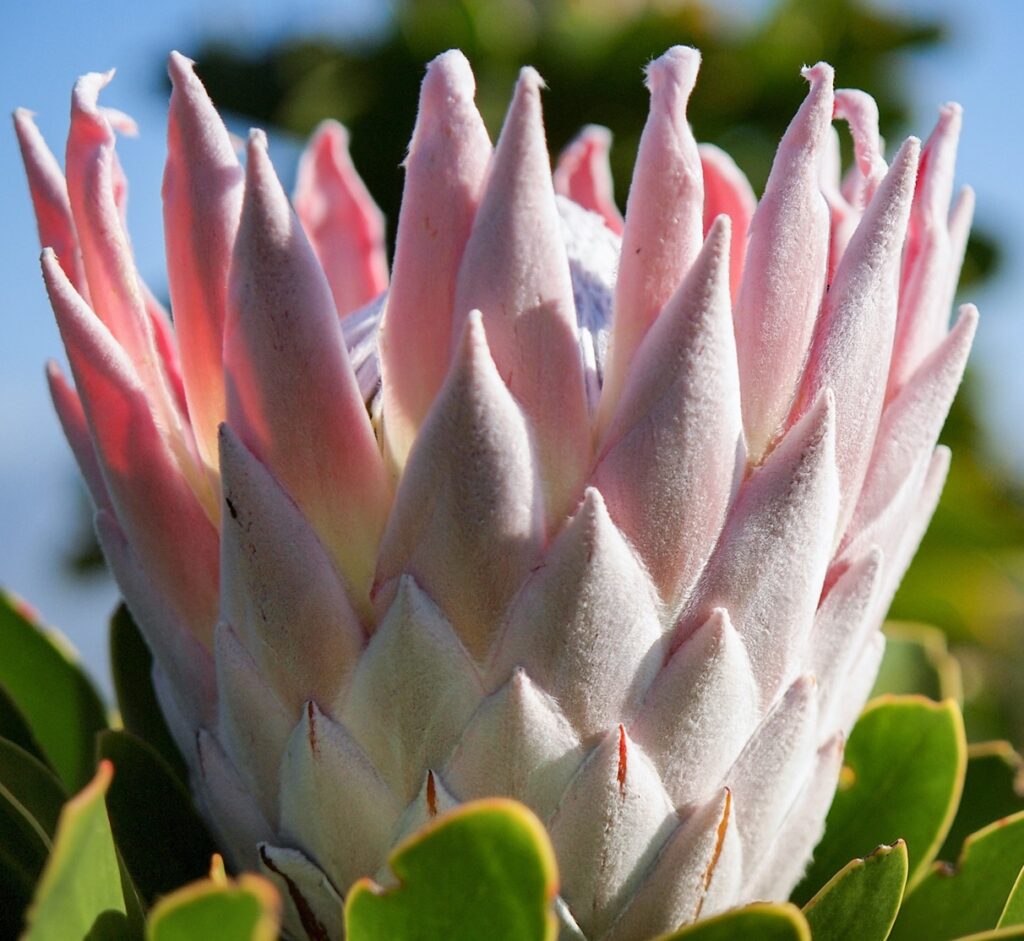
Protea flowers are among the most distinctive in the plant kingdom, but what appears to be a single large flower is actually a flower head (an inflorescence) made up of dozens to hundreds of tiny individual flowers, known as florets. These florets are densely packed into a central dome or cone and surrounded by large, often brightly coloured bracts – specialised modified leaves that protect the developing flowers and attract pollinators. The result is something that feels simultaneously familiar and alien. They are also tactile flowers. Their surfaces invite closer inspection: soft hairs, hard scales, waxy leaves, papery textures and intricate patterns. They photograph beautifully because they offer so many layers of detail. Proteas have character. They suggest resilience. They are flowers shaped by fire, poor soils, wind, drought and the relentless forces of evolution – and yet they emerge from this difficult world with sublime elegance.
A name worthy of a shape-shifter
The name Protea comes from Proteus, a shape-shifting figure in Greek mythology. The name was chosen by Swedish botanist Carl Linnaeus in 1735, inspired by the remarkable variety of shapes and forms found among protea species. In Greek mythology, Proteus was an ancient sea god known as the “Old Man of the Sea,” a shepherd of Poseidon’s sea creatures who possessed knowledge of the past, present and future. He was famously reluctant to share his wisdom and would use his singular ability to shape-shift into animals, trees, fire or water to escape anyone who tried to capture him. His name is associated with the ancient Greek root prōtos, meaning “first” or “primary,” and the word protean, meaning changeable or capable of assuming many forms. It was this remarkable diversity of form that has made the mythological figure an apt namesake for a group of plants renowned for their variety of shapes. In Homer’s book The Odyssey, Greek hero Menelaus caught Proteus on the island of Pharos, holding tight through all the shape-shifts until the deity gave him directions home.

From epic tales to ecological wonder; the protea is a survivor of fire and drought, and a specialist of growing in nutrient-poor soils. It is a source of food for birds, insects and mammals. A partner in intricate ecological relationships. A product of millions of years of evolution. An important part of South Africa’s horticultural economy. A symbol of a country. And, perhaps most importantly, a living ambassador for one of the most extraordinary ecosystems on the planet: the Cape Floral Kingdom. The Cape region of South Africa is famous for its fynbos shrubland made up of approximately 9,000 species, 70 percent of which is found nowhere else. Among its most striking flowers are proteas, including the king protea, a regal bloom which has a large, crown-like flower head.
A masterpiece of adaptation
Proteas evolved in a difficult world. Fynbos soils are often exceptionally low in essential nutrients such as phosphorus and nitrogen. For many plants, this would be a severe disadvantage. For proteas and their relatives, it became an evolutionary challenge to solve. Many Proteaceae have specialised proteoid roots, also called cluster roots. Instead of producing a few ordinary roots, these plants develop dense clusters of short lateral rootlets. These structures dramatically increase the surface area available for nutrient absorption and can release organic compounds into the soil that help make otherwise inaccessible nutrients available to the plant. It is an elegant solution to an apparently inhospitable environment.
The protea also has a special relationship with fire. Fynbos is a fire-driven ecosystem, and many of its plants have evolved strategies that allow them not merely to survive fire, but to reproduce in a landscape where fire is an ecological necessity. Some proteas are resprouters. Their above-ground stems may burn, but protected buds or underground structures allow them to regenerate. Others are reseeders. The adult plant may be killed by fire, but its seeds survive in specialised structures and are released after the fire has passed. In some species, the old flower heads remain attached to the plant for years, forming woody structures that protect the seeds which can act almost like natural seed banks suspended above the ground.
The protea also offers us a lesson in resilience. Fynbos soils are often extremely poor in nutrients, particularly phosphorus. To survive in these conditions, many members of the Proteaceae have developed specialised structures known as proteoid, or cluster, roots. These dense clusters of fine rootlets increase the plant’s ability to access scarce nutrients and are part of a sophisticated adaptation to its environment. They remind us that biodiversity is not an abstract scientific concept. It has a face. It has a shape. It has colour. It blooms.
One flower head. Hundreds of individual flowers. An entire ecosystem gathered around it.
The Proteaceae family is up to 132 million years old, making it one of the oldest families of flowering plants. Fossil pollen and molecular studies suggest that the family originated during the early Cretaceous Period, when dinosaurs still dominated the Earth and the southern continents were joined together as the supercontinent Gondwana. The genus Protea itself is much younger than the family, although still ancient by human standards – evolving roughly 25 to 40 million years ago – after Africa had already separated from the other continents. The fossil record even shows evidence of proteaceous plants once growing on the now-frozen continent of Antarctica. It subsequently diversified within southern Africa, particularly in the Cape Floral Kingdom, where changing climates, rippled mountains and varied soils drove the evolution of the exceptional diversity of protea species we see today.
Proteas and the global flower trade
In 2025 South Africa exported approximately ZAR1.21 billion worth of cut flowers, with King Proteas – our largest flower export accounting for close to ZAR 275 million of the total. This economic importance is itself worth recognising. Protea cultivation contributes to horticulture and provides livelihoods, while the global popularity of these flowers helps introduce people around the world to South Africa’s botanical heritage. South African-grown proteas and other fynbos flowers are a notable part of an international cut-flower industry, with their unusual forms and excellent vase life making them highly desirable in floral arrangements. Species such as Protea magnifica are cultivated for export because of their long stems, long-lasting flower heads and good ‘vase life’. However, the cultivation of proteas near wild populations can raise conservation concerns when genetic material from cultivated plants mixes with natural populations. The challenge is therefore to ensure that our appreciation of proteas does not come at the expense of the ecosystems that created them.

A protea grown for export may travel across the world, but the wild protea belongs to a much larger story. The diverse Proteaceae family has more than 350 species in South Africa – out of more than 1,700 known species in the Southern hemisphere. Its status as our national flower offers the King Protea some protection, but today almost half of South Africa’s other protea species face extinction because of pressures on their native habitats in the Western Cape, with certain species that only occur in tiny pocketed ranges – making them uniquely vulnerable. The threats to our proteas and fynbos in general include habitat loss due to human development and agriculture, the proliferation of invasive alien species such as acacia cyclops (Rooikrans) and inappropriate fire regimes that are occurring too frequently due to climate change. Most proteas are endemic to the Cape Floral Kingdom biome that stretches across the southern tip of South Africa – one of the world’s richest flora biodiversity hotspots. However, over the past 40 to 50 years we have converted a lot of lowland fynbos for wine and wheat farming, and other forms of agriculture – due largely to the desirability of their alkaline soils – pressing fynbos biomes such as the fractured Renosterveld into critically endangered territory.
The flower that feeds a web of life
A protea flower head is a biological marketplace. Its nectar can provide essential energy to birds and insects, while the flowers facilitate pollination by a variety of visitors. Cape Sugarbirds are perhaps the most famous protea associates. These remarkable birds are strongly linked to protea-rich habitats, feeding on nectar and helping to transfer pollen between plants. Sunbirds also visit proteas, as do bees, beetles, moths and other insects, with up to 2,000 individual insect visits to a single flowerhead during its flowering season. This diversity of pollination strategies reflects the adaptability of the Proteaceae. Different species have evolved different relationships with their pollinators, and these relationships help explain the astonishing variety of flower shapes, scents and structures found within the family. Protea seeds can become food for birds and mammals. Their structures provide habitat and shelter for small organisms. These relationships remind us that a flower is not an isolated object. It is a meeting place. Even a single flower can represent an entire network of relationships. Their flowers support pollinator populations. Their roots interact with the soil microbiome. Their presence is an important part of a complex network of plants, animals, fungi and microorganisms that collectively make up fynbos.
A flower family in decline
Today nearly half of South Africa’s protea flowering plant species face extinction, with some wild populations having dwindled to a single individual hanging on by a thread. The International Union for Conservation of Nature’s Red List of Threatened Species – the world’s indicator of the health of species biodiversity – has in recent years released a comprehensive assessment of the southern Hemisphere’s protea plant family, finding 637 of the 1464 known species are vulnerable, endangered or critically endangered. The outlook for these plants is not promising. The assessment, carried out by the South African National Biodiversity Institute [SANBI] and fynbos experts, revealed that 47 percent [165 of 353] of local species face extinction – demonstrating clearly for the first time that our South African species are among the most threatened.
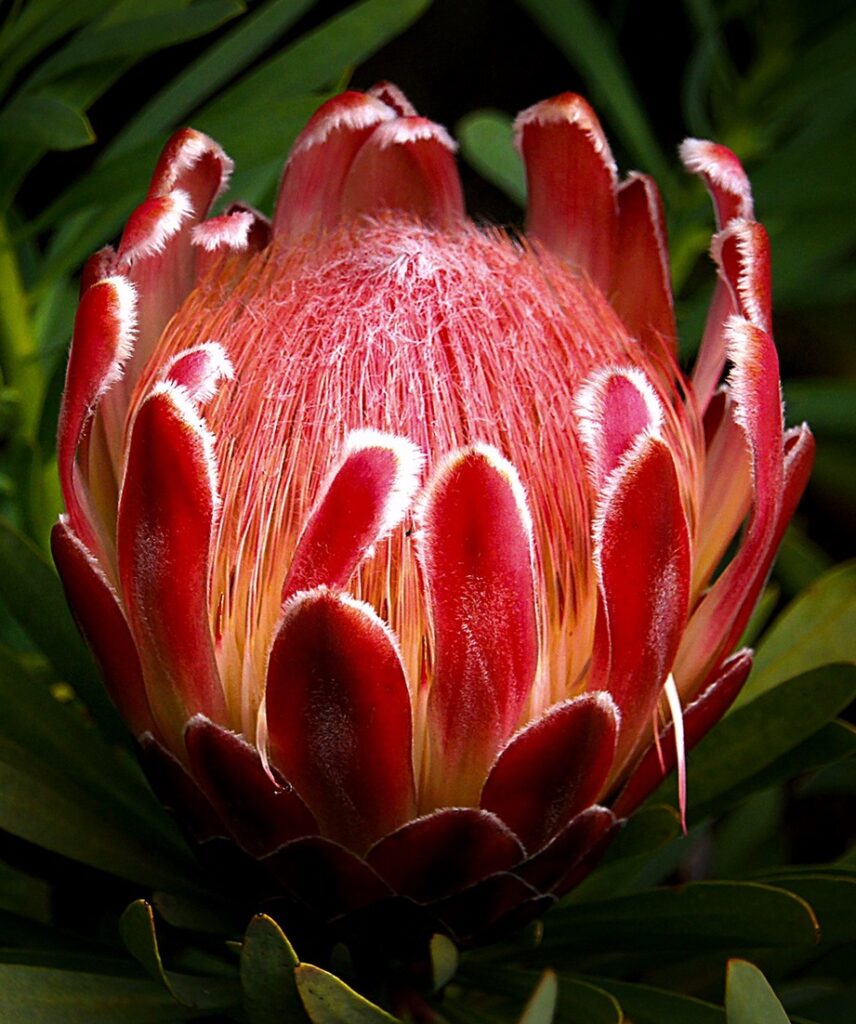
When fire passes, the protea remembers how to begin again. Some species can resprout after fire, regenerating from protected parts of the plant. Others are killed by fire but reproduce through seeds that have been protected until the conditions are right for germination. In some species, seeds are held in old flower heads for extended periods, waiting for fire to clear the vegetation and create an opportunity for new growth. But it also reminds us that resilience has limits. Fire must occur at the right intervals. If fires become too frequent, plants may not have enough time to mature and produce seed. The relationship between proteas and fire is therefore not a simple story of destruction followed by renewal. It is a finely balanced ecological process, and different species have evolved different requirements. The protea is resilient, but it is not indestructible – a distinction that matters in a changing world.
Proteas, policy and population
World Nature Conservation Day, observed annually on 28 July, is a reminder of our shared responsibility to protect the natural world and the biodiversity that sustains life on Earth. It highlights the importance of conserving ecosystems, wildlife, forests, oceans and natural resources while encouraging sustainable ways of living. In South Africa, this includes protecting the unique Cape Floral Kingdom. Conserving proteas means protecting far more than beautiful flowers – it means safeguarding the intricate ecosystems, pollinators and wildlife that depend on them, and preserving one of the world’s greatest botanical treasures for future generations.
Much can be said about the inadequacy of national conservation policies. At present the South African government plans to introduce a more flexible Environmental Impact Assessment process [EIA] that could weaken public participation, undermine proper scientific scrutiny and increase the incentives for corruption by gatekeepers atop the approval ladder – raising the risks and damage from human development on natural ecosystems and their services to society. The release of the new EIA framework is anticipated during August 2026.
Earth Overshoot Day has been calculated by the Global Footprint Network to fall on 30 July this year. This is the annual date – usually between July and August – when humanity’s demand for ecological resources in a given year exceeds what Earth can regenerate. Our civilisation currently uses as many ecological resources as if we lived on 1.7 Earths – raising concerns on the compounding effects, year upon year, of going over-budget on what our environment can sustain. Ending overshoot is essential, but also possible – given human creativity. “We are stretching the limits of how much ecological damage we can get away with – it is now a quarter into the 21st century and we owe the planet at least 20 years of ecological regeneration, even if we stop any further damage now. If we still want to call this planet home, this level of overshoot calls for a scale of ambition in adaptation and mitigation that should dwarf any previous historical investments we have made, for the sake of our common future,” comments a board member of Global Footprint Network.
“Carrying capacity” is a term used by ecologists to describe the number of individuals an environment can support over the long term without exhausting its resources – applying equally to humans as it does to any other species such as, contentiously in our present conservation discourse; elephants. One study examined both Earth’s maximum population capacity, regardless of quality of life, and a more sustainable figure that assumes people maintain a reasonable standard of living. Accordingly, Earth can sustainably support about 2.5 billion people, roughly the size of the global population in the mid-20th century. The current population is about 8.3 billion.
At a time when world leaders should be working to slow down population growth by investing in women and girls and supporting reproductive autonomy – many nations are pursuing misguided pronatalist policies to try to encourage their citizens to have more children out of concerns for labour shortages and economic growth. According to the United Nations, 55 countries had policies aimed at raising fertility in 2021. However, the countries with the highest fertility rates are generally those with the worst gender inequalities.
The loss of protea species in an environmental crisis. The environmental crisis is as much a crisis of perception as it is technological, economic, agricultural and demographic. It’s a water crisis. It’s a health crisis, and it’s also a food security crisis.
Proteas are worth appreciating because they have survived where many plants could not. Evolving in ingenious ways of finding nutrients in poor soils, learning to live with fire, simultaneously feeding and depending upon an intricate web of life. Because it tells the story of the Cape Floral Kingdom. Because it is part of South Africa’s identity. Because it supports livelihoods and connects our natural heritage to the wider world. And because, in a single extraordinary flower head, it reminds us of one of nature’s most important truths: that complexity emerges from connection.
The flowerbeds of the world’s devices
Perhaps this is why the protea has become such a powerful symbol. It represents South Africa not simply because it is beautiful, but because it embodies something fundamental about the country itself: extraordinary diversity shaped by extraordinary conditions.
Says Gill Simpson, founder and director of the Wild Rescue nature reserve, “To appreciate proteas fully is to appreciate them in context. It is to understand that the flower is only one part of the story. The landscape matters. The soil matters. The fire matters. The pollinators matter. The surrounding plants matter. And the people who protect these ecosystems matter. This is perhaps the greatest reason we should appreciate proteas: they give us a way to appreciate the interconnectedness of nature. In an age when biodiversity loss can sometimes feel distant and overwhelming, the protea gives us something tangible to care about. It gives us a flower we can recognise and a story we can understand. We can look at it and know that it represents something larger. It represents the fynbos. It represents South Africa. It represents resilience. It represents biodiversity. It represents the creativity of evolution. And it represents the fragile relationship between humans and the natural world.”
It is fitting that the protea should have a place not only in our landscapes but also in our language. We live in a world where we increasingly communicate through images. Emojis have become part of the way we express ourselves, allowing a tiny symbol to carry meaning across languages and borders. We have digital flowers representing roses, sunflowers, cherry blossoms and many other familiar blooms. If an emoji is a tiny ambassador for the things we value, then the protea deserves consideration.

A protea emoji would not simply represent a flower. It could represent South Africa. It could represent fynbos. It could represent biodiversity. It could represent resilience and renewal. It could represent the idea that something can be both beautiful and ecologically important. Most importantly, it could help introduce this distinguished plant to people who may never have encountered one in the wild. Of course, no emoji can replace the experience of seeing a protea growing in its natural habitat. No digital symbol can capture the scale of a king protea, the texture of its bracts, the scent of the surrounding vegetation or the sound of a sugarbird moving through the flowers.
The Wild Rescue nature reserve is currently campaigning to bring a protea emoji to the Unicode Standard of the world’s devices. An improved level of awareness and appreciation will contribute to helping protect our natural fynbos habitats, and encourage simple actions that can make profound differences. The protea has travelled from the mountains of the Cape to gardens and flower markets around the world. Perhaps its next journey is onto everyone’s digital platforms.