

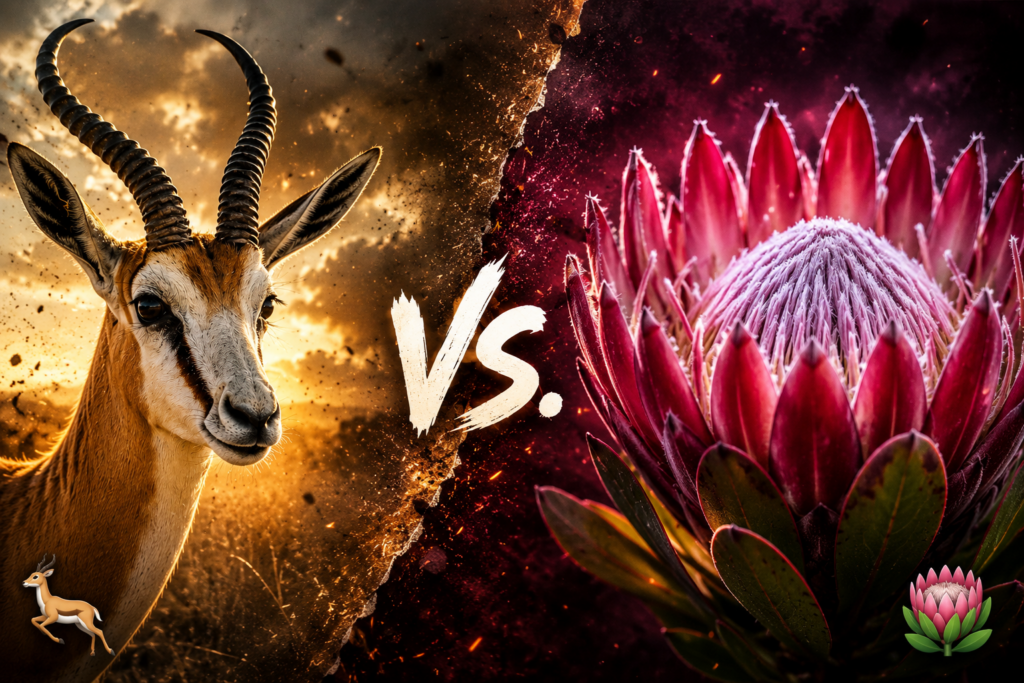
To springbok, or to protea? That is the question. (or is it?)
Aesop’s Fables is a famous collection of short stories from ancient Greece, using animals that talk and act like people to endow young minds with simple morals. Replete with natural rivalries; you may have heard of tales such as Tortoise 🐢 vs. Hare 🐰 (slow perseverance vs speed and arrogance), Lion 🦁 vs. Mouse 🐁 (strength vs. smallness) or Ant 🐜 vs. Grasshopper 🦗(industry vs. frivolity). Some epic contests were written by Aesop, some by Melville and some by Shakespeare. But for today’s texting habits, South Africa is seemingly writing its own: the Springbok vs. the Protea.
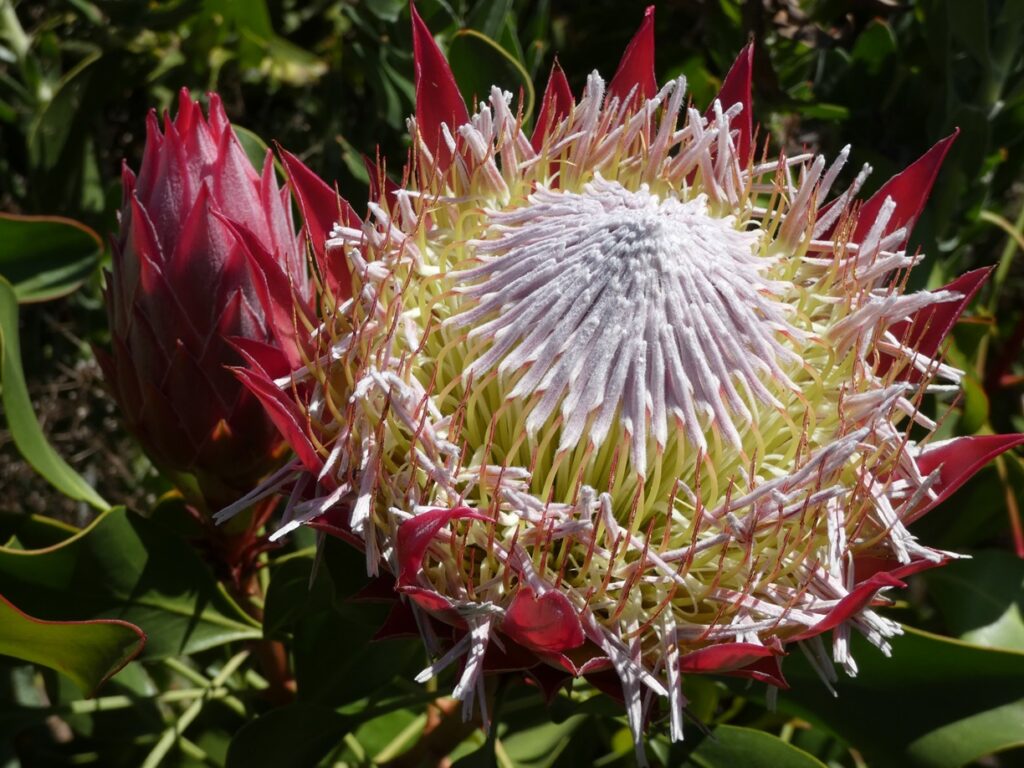
Wild Rescue’s recent campaign to have the Unicode Consortium approve a Protea emoji for global integration received cheerful media coverage and feedback from the public. Apart from highlighting conservation challenges around these Fynbos flowers, the conversation on some live channels quickly took to issues around our national identity and sports – which, of course, the Springbok and the Protea as symbols would reflexively invoke on our soil – with the Springbok representing the national rugby teams, and the Protea (as the national flower) also representing our cricket and other teams*.

On Smile FM’s segment titled “What South African Emoji Should Be Created?”, the question was posed: “If South Africa was going to campaign for one emoji, are we choosing the protea flower and not a springbok?” With preferences leaning springbok; one speaker (😇) mistook the Protea sussannae used as a model for the exemplar emoji submitted to the Unicode Consortium for a King Protea (because from the lofty bird’s-eye view of a Cape Town radio studio all members of this highly diverse family look alike?). Simultaneously, a presenter of the “The Goeiemôre Good Morning” live breakfast TV show on VIA swiftly pined for rugby representation in his choice of symbols, calling for springbok emojification. And thus an apparently zero-sum national contest has been created between a horned antelope and a so-called sugarbush.
To the casual observer, juxtaposed, both cases have merit.
Outside of a mammal-rich nature reserve, the mention of “Springbok” is usually taken as a reference to the national rugby teams – famous for winning World Cups – while “Proteas” just as automatically allude to the government’s favourite flower and our top-tier cricket squads – not entirely so famous for winning World Cups. And also as a flagship species of our Cape Floral Kingdom: home to over 9,000 to 9,600 known plant species, with around 70 percent of them found nowhere else on Earth – fynbos is largely synonymous with Proteas, and may be one of few indigenous species names that are ubiquitously known throughout the country. So far – we have parity between Springboks and Proteas for recognisability.
Now for a minor but necessary digression regarding “Springbok” sports teams*:
You see, historically, “Springbok colours” were not exclusive to rugby. Over a hundred years ago, the famous Green & Gold Springbok blazer became the highest national sporting honour and was awarded to South Africans representing the country internationally in many different events – from boxing to shooting to synchronised swimming. For example, Wits University records that its entire 1980 rowing squad received Springbok colours, while also recording Springbok representatives in hockey and skydiving. In bygone decades the “Springbok” title has genuinely functioned as a national sporting identity across multiple sports.
After South Africa got democracy, the government moved towards one national sporting symbol: the Protea. The Springbok emblem and colours were largely replaced for other sporting codes, with rugby being the big exception. The South African Sports Commission’s regulations subsequently established the King Protea as the national sporting symbol, while allowing rugby to retain the Springbok alongside it. The South African Powerlifting Federation, for example, explicitly states that Springbok colours ceased to be awarded to sports other than rugby at the end of 1993, with the Protea taking their place. Interestingly, the use of “Springbok” as a blanket term for any national-level sports competitor is still occasioned in conversation, and something of a holdover of the old era. But they are ‘springbok-ing’ incorrectly – while it’s almost impossible to be protea-ing incorrectly, based on actual emblems on current team regalia. Nonetheless, per capita, in this 21st century there are now far more sporting proteas then there are sporting springboks.
In any case: If this was a contest of diversity; then there are about 112 described species in the Protea genus, while the wider protea family – Proteaceae – contains around 1,660 species worldwide. Woe unto the Springbok with only one species (Antidorcas marsupialis) divided into three recognised subspecies. The Proteaceae family of flowering plants originated approximately 132 million years ago during the Cretaceous period, whereas the Springbok lineage first evolved approximately 3 million years ago during the Pliocene epoch from gazelle-like ancestors. So if “evolutionary seniority” was a factor (which it isn’t) this one would go to the flowers.
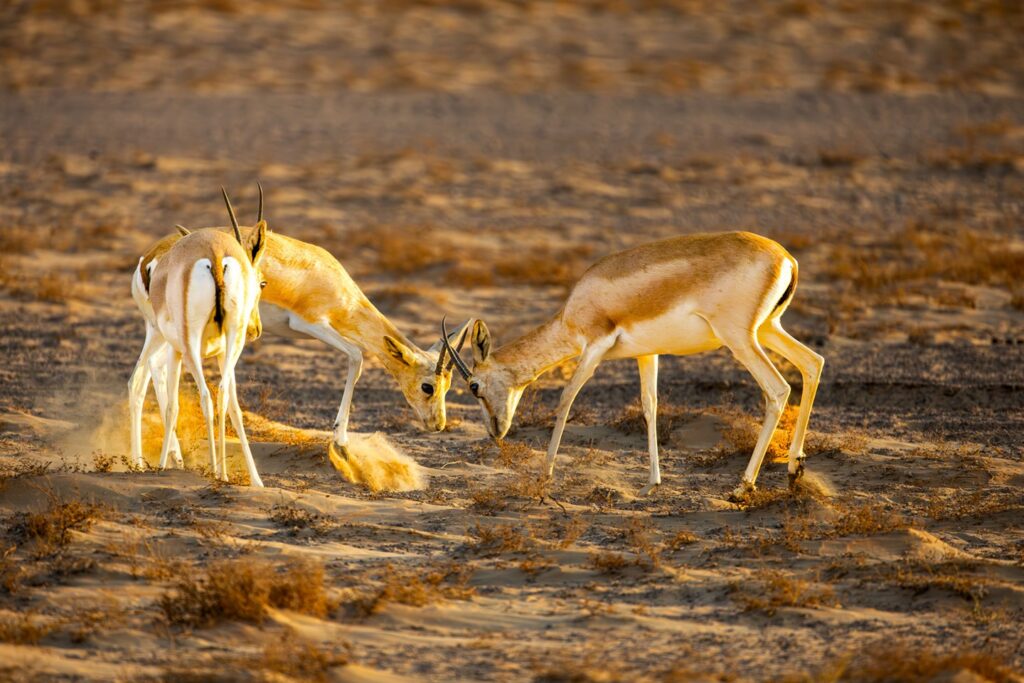
Sensing defeat for our rugby teams, you might argue “but South Africa loves springboks! However, that would not be enough as Unicode explicitly states that popularity, petitions and ‘for-a-good-cause’ proposals are not a justification – and with nearly 4,000 emojis already available in the Unicode Standard, approvals are deliberately difficult: only a very small percentage of submitted proposals advance to encoding. Proteas, concordantly, do not get a sympathetic ear from Unicode because nearly half of their species are now endangered. Conservation, national pride, petitions, hashtags, etc. can support the story, but cannot be the reason for encoding the emoji.
Factors for Emoji Exclusion
Among the conditions for approval is that a new emoji needs to fill a gap in the existing emoji set and not duplicate an emoji that already exists. The main question is 1) whether the concept can be presented by another emoji or sequence – even if the image isn’t exactly the same.
Consider the bee.
Unicode already has a bee emoji: 🐝
A bee-lover might insist that different bees deserve distinct emojis (because of course these highly-industrious pollinators and honey-machines do) when in fact there are more than 20,000 known species of bees that can’t possibly all have an emoji individually and the existing symbol 🐝completely adequately represents all of them without being 2) overly specific.
‘Braaivleis’ – meat grilled on an open fire – is a national cuisine and obsession in South Africa and would be a strong contender for emoji-dom if pure popularity were a qualification (which, again, is sadly not the case). While braaivleis has numerous local variants in preparation and flavouring, the standard emojis used to represent grilled meat or a barbecue are the meat on bone 🍖 and the cut of meat 🥩 – perhaps with the combination of fire🔥. Braaivleis is already presentable by these options, and to demand a unique braaivleis emoji would be overly specific.
Next up after sports and food our fellow South Africans would likely prioritise a ‘brandy & coke’ emoji as a beloved national mixed alcoholic drink. But yet again we already have a tumbler glass emoji 🥃 (used for brown liquors) combined with a soft drink emoji 🥤(used for a range of non-alcoholic beverages) combined for adequate representation.
Having said that; the Springbok is one of 91 to 93 recognised species of antelope worldwide, already illustrated by 🦌 (used to represent elk, moose, antelope, or reindeer). As with bees – unless you come up with a special argument – the multitudes can be reasonably reducible to one meaningful design. Alongside goats, sheep, llamas, zebras, horses, giraffes and camels that already have their symbols; on the strength of this criteria, a proposal for a springbok emoji doesn’t really have legs.
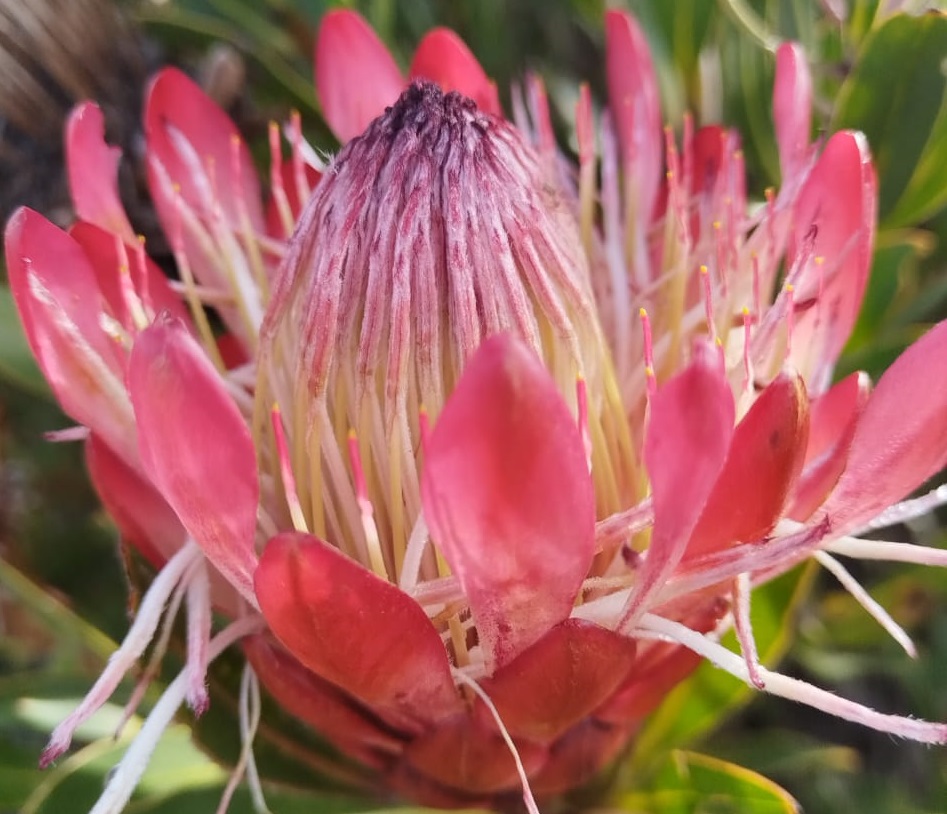
As for the Protea: Presently there are several floral options available in the emoji selection, though there may be some latitude that remains for completeness.
In the existing set there is a bouquet 💐(representing gifts or ceremonies), a cherry blossom 🌸 (representing new beginnings and famously a post-World War 2 symbol of harmony), a white flower 💮 (for innocence and purity in general, however the tiny Japanese script on this flower 大変よくできました reads “Taihen yoku dekimashita” – translating to “You did very well!” or “Great job!”), a lotus (largely an icon for spiritual enlightenment and a proxy for Eastern religious traditions such a s Buddhism), a rosette 🏵️(not a specific plant, but a stylised flower motif that historically symbolised eternity and royalty), a rose 🌹 (a red rose conveys love and passion generically – and in England the symbol of the House of Lancaster from the Wars of the Roses. The “English Rose” epithet refers to archetype of a naturally beautiful woman with rosy cheeks), a wilted flower 🥀(a versatile symbol used to express sadness, grief, romantic loss, or heartbreak), a hibiscus 🌺 (representing delicate beauty and feminine power), a sunflower 🌻 (for loyalty and lasting happiness), a tulip 🌷(represents hope and charity, associated with mass cultivation in the Netherlands), and hyacinth (represents playfulness and sincerity – but is also notorious as one of the world’s most aggressive invasive flowering weeds in rivers).
From their origins, use and native areas – we have Europe, the Americas, Asia and the far East, identified with the Global North – whereas an African or Global South variety of flora (such as from the Cape Floral Kingdom) is missing from the group.
If by this point you’re starting to realise that the business of emoji-making is in fact complicated and rigorous, it’s a handy moment to review Unicode’s draconian guidelines for submitting proposals (closed until 2027).
How Emojis Get Approved for Encoding
Proposals need to demonstrate that a new emoji would:
- Demonstrate strong, broad usage – with empirical evidence from Google Search, Google Video Search, Google Trends (web + images), and Google Books Ngram.
- Show multiple meanings or concepts, where possible.
- Show useful combinations with other emojis. For example: 🚪 🏃♀️ 💨: time to leave quickly – or 🕳 👨🦯: pretending not to see something or looking away from drama.
- Break new ground – not simply duplicate something already adequately represented (as discussed above).
- Be visually distinctive and recognisable, including at very small scales down to 18×18 pixels.
- Address completeness/compatibility, where genuinely applicable.
- Overcome exclusion factors: it shouldn’t already be representable, be overly specific, create an open-ended category, be transient, or merely be justified by an existing emoji.
- Don’t base the case on a “cause”: For both the springbok and protea, usage evidence + distinctiveness + demonstrating that they aren’t adequately represented by existing emoji would likely be critical battlegrounds for approval.
By now, nobody can be blamed for feeling unenthused about the tricky prospect of submitting their own emoji proposal to Unicode – if they’ve wanted to do so. 😂
How You Can Help to Get an Emoji
A weighty factor considered by the Unicode Consortium is evidence that people genuinely want and would use a particular emoji, as demonstrated by online activity.
Anyone can support such a campaign by:
- Searching on Google for “protea”, “protea flower” – or for that matter “springbok” whenever a proposal for such and emoji has been submitted*
- Sharing images, videos and stories about Proteas (and then springboks*) on websites and social media
- Even the number of published volumes on the subject and the frequency of these words found in digitised books gets taken into account (so go write books about proteas and springboks 😉)
Key Takeaway: Every search and every post about the topic is a vote for emoji approval.
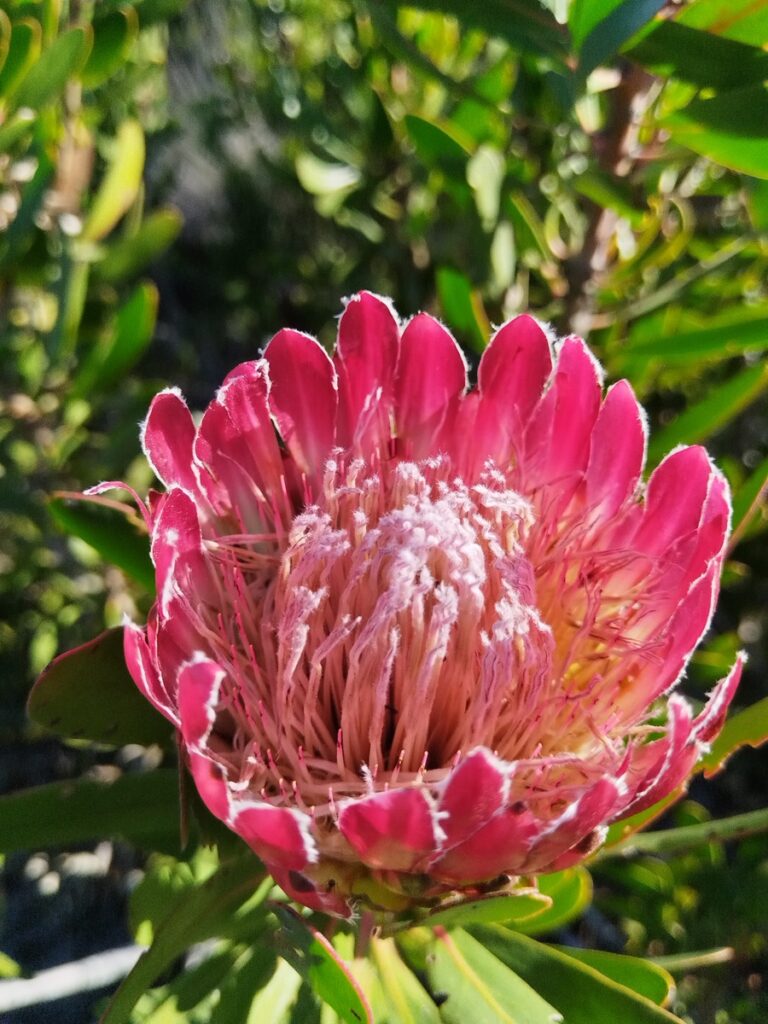
And now for a brief detour on emoji design:
This may come as a surprise, but while you can get an emoji approved for use by Unicode; you have little to no actual say regarding what it will look like.
Unicode decides which emojis become part of the international system that allows electronic devices to represent text and symbols consistently – however – the Consortium doesn’t actually design the emojis – it only determines which characters should be represented. Every leading platform integrates artwork based on their own internal styles, often creating an independent version or rendering to complement the look & feel of their existing emojis. Compare for example Apple vs. Mozilla. This is why every emoji can look different depending on the specific device, operating system and applications being used – even though it’s the same Unicode character. Side-by-side comparisons of variants across platforms make major differences obvious. It’s true that every proposal the Unicode must be accompanied by a novel design for the emoji – but this is merely an example, for review purposes. Once approved, every major platform designs their own version of the emoji (even if you’ve run a well-meaning design contest) – while smaller platforms without as much design capacity may copy or emulate emojis used by larger organisations, tools, apps and services. However, unless something has gone horribly awry you will still recognise your shiny new emoji. After all, a smiley-face is a smiley face is a smiley-face – but there are myriad ways in which to draw one. In short: you can have your emoji – you just can’t dictate what it will look like everywhere.
As for the parameters of the design itself – a major factor for approval is whether a proposed design scales down well to smaller sizes. Emojis are not large images – they’re relatively tiny. They are also not scientifically accurate drawings – they are, if anything, cartoonish. Fine details of a realistic depiction are either lost or don’t scale well to a miniscule compression (please feel free to experiment). This is why larger versions of emoji designs may appear disproportionate or technically inaccurate – because the point is to make something that is recognisable and distinct once significantly minimised, and failure to do so is a disqualification. For example: a deliberately somewhat oak-leaved Protea sussannae still has recognisable leaves when downsized – whereas a slimmer profile of leaf would either look strange or disappear entirely.

Springboks vs. Proteas
For the sake of argument, let us compare the essential metrics of Springboks to Proteas. Note that the Unicode Consortium uses the search term “elephant” on all proposals as a baseline for comparison. Everyone has to measure up, statistically speaking, to the hefty yardstick of the largest living land mammal.
Search results are a key motivator – as we’ve covered. The more content available online for a given term, the higher the proof as a topic of interest. These are (approximated) current results for each term:
“protea”
- Google Search: 16,800,000
- Google Images: 11,000,000
- Google Videos: 1,670,000
- Google Books: 1,000,000
“springbok”
- Google Search: 16,100,000
- Google Images: 7,730,000
- Google Videos: 2,830,000
- Google Books: 1,000,000
While the Unicode Consortium unfortunately does not provide minimum acceptable thresholds for these numbers, they are roughly equivalent for proteas and springboks with the moderate exception of video results – likely due to sports events coverage – which unfortunately muddies the numbers in a way that does matter to Unicode. Not that it is necessarily a disqualifier, but the tusked giant dwarfs them both in most criteria:
“elephant”
- Google Search: 503,000,000
- Google Images: 54,900,000
- Google Videos: 94,400,000
- Google Books: 1,000,000
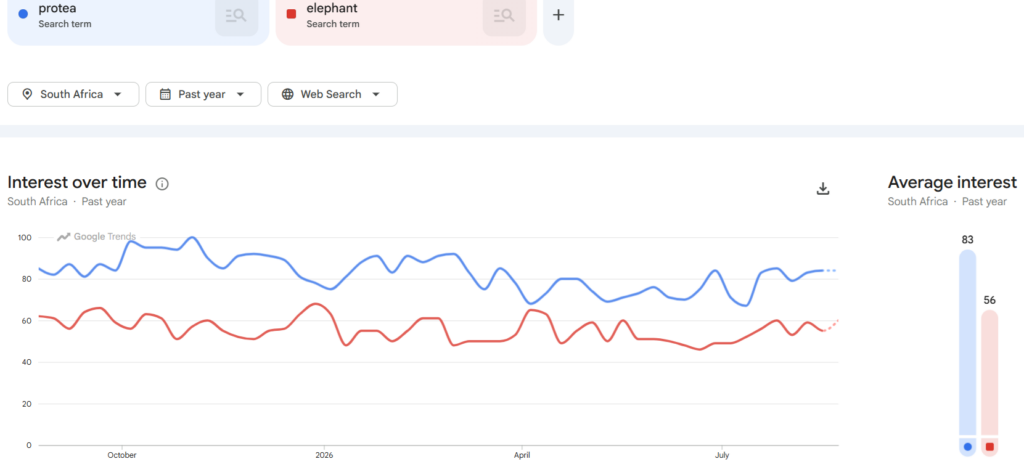
In Google Trends, Springboks champion over Elephants for searches in South Africa:
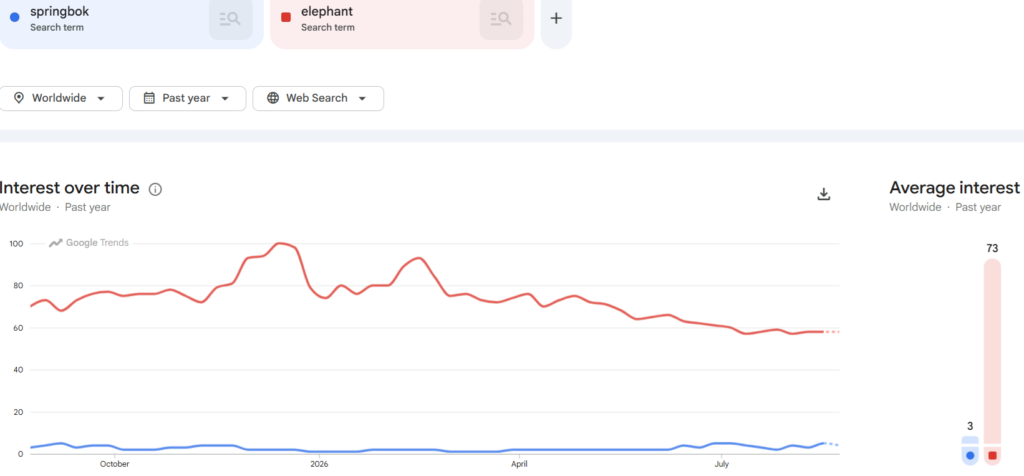
Worldwide however, Elephants crush Springboks in terms of interest. Perhaps size does really count:
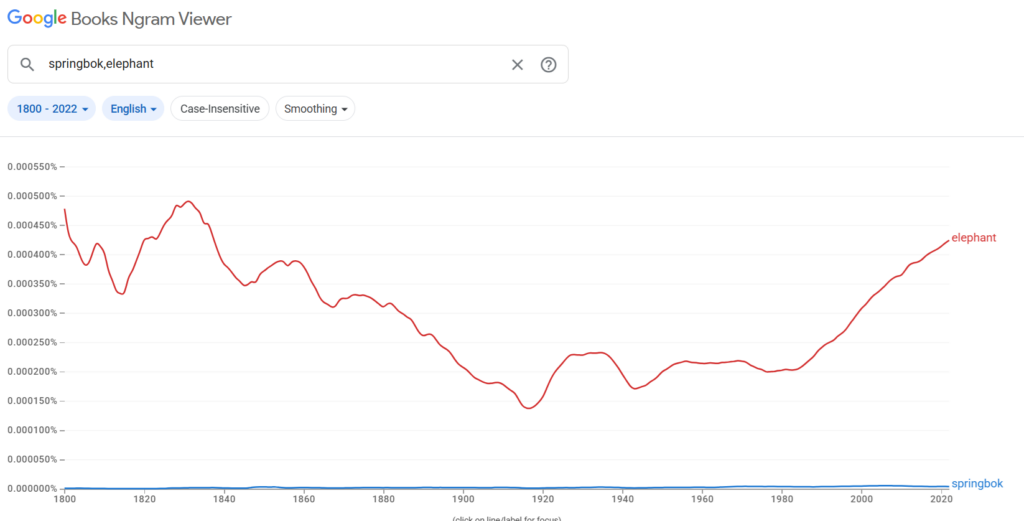
Ngrams for mentions in books reflect Elephant dominance compared to Springboks:
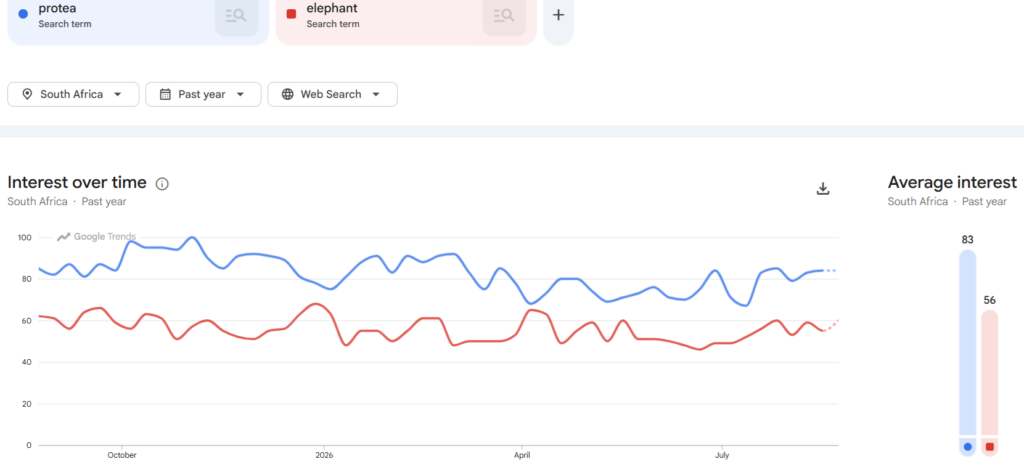
Similarly, Proteas perform well against Elephants on our shores:
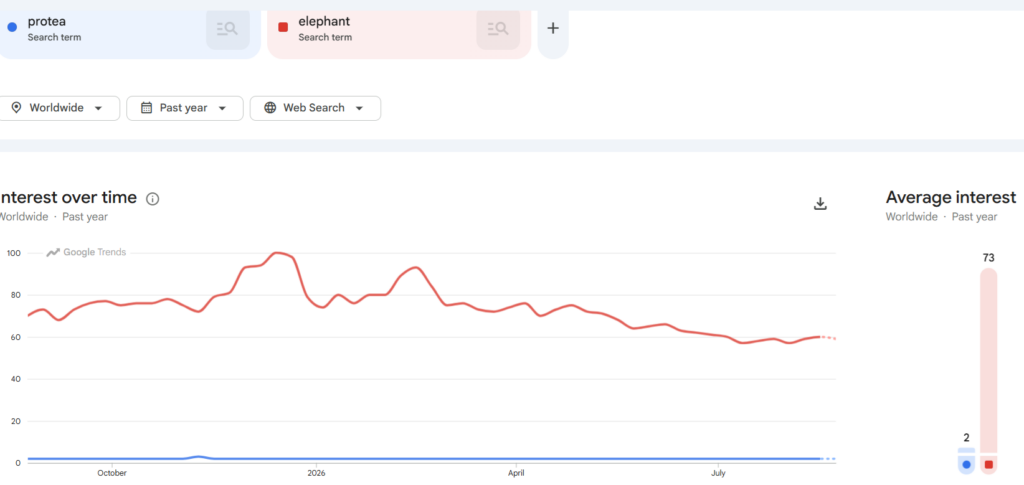
But largely topple in standing through the lens of worldwide searches:
Ngrams for Proteas nearly flatline when weighed up to elephants:
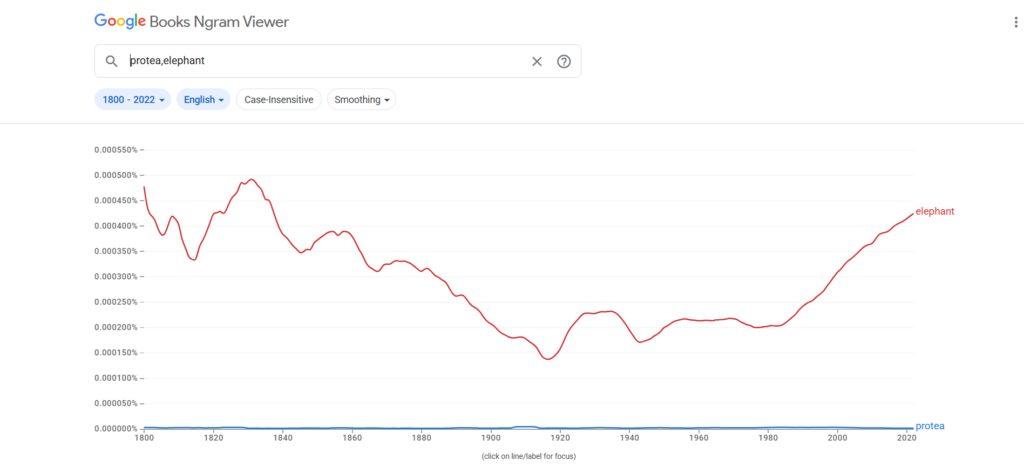
Regional fame finds its context within global relevance. Once again – the use of the term “elephant” is merely as an equal line of comparison for all applicants. Are these measures enough to qualify either Springboks or Proteas for an emoji? We simply don’t know.
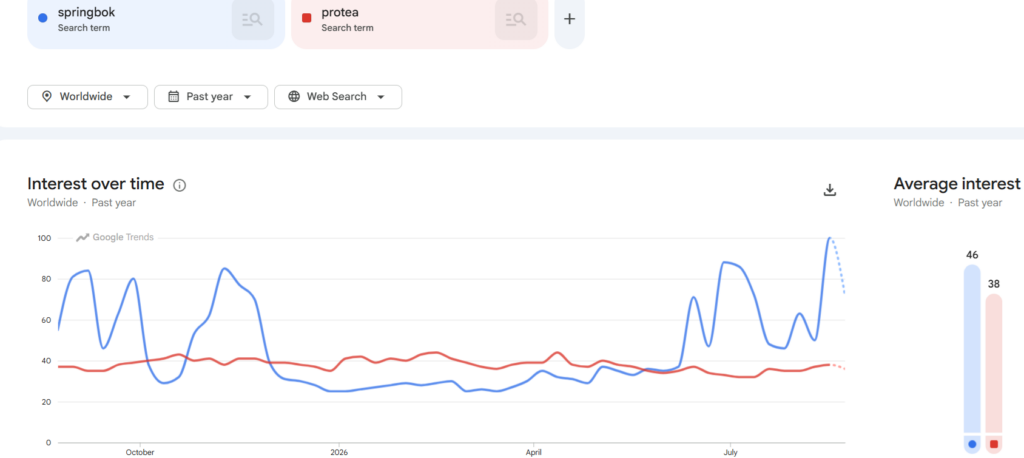
Just for comparison: springboks and proteas trend roughly equally for the majority of the graph, apart from strong spikes in interest in springboks – presumably around match or tournament periods when there’s naturally more excitement and interest.
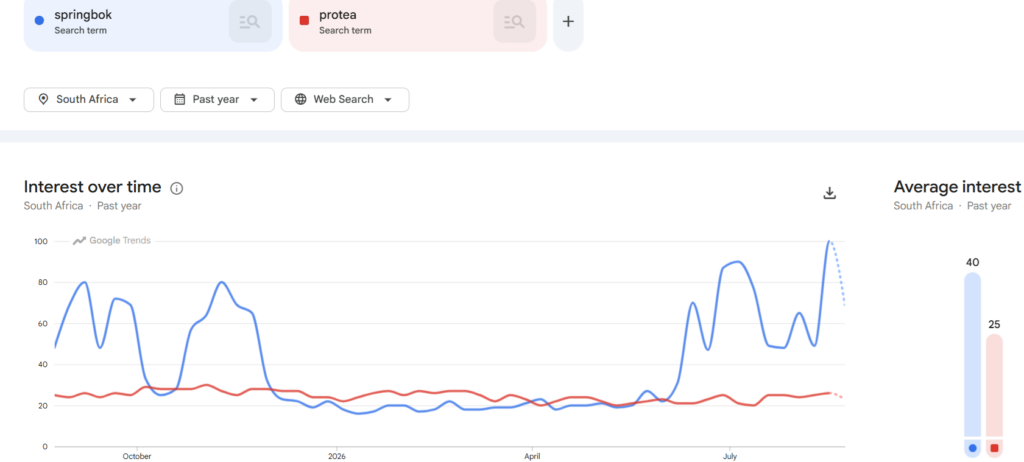
Worldwide interest shows a broadly similar pattern:
Which emoji would be victorious?
Taken together; including factors for exclusion, being overly specific, being already presentable, filling a gap in the existing emoji set, not duplicate an emoji that already exists, distinctiveness and completeness – the protea presents the stronger of the two cases – while in terms of the key metrics they are fairly balanced. If our Wild Rescue proposal doesn’t qualify for getting a protea, then we probably won’t qualify for getting a springbok either.
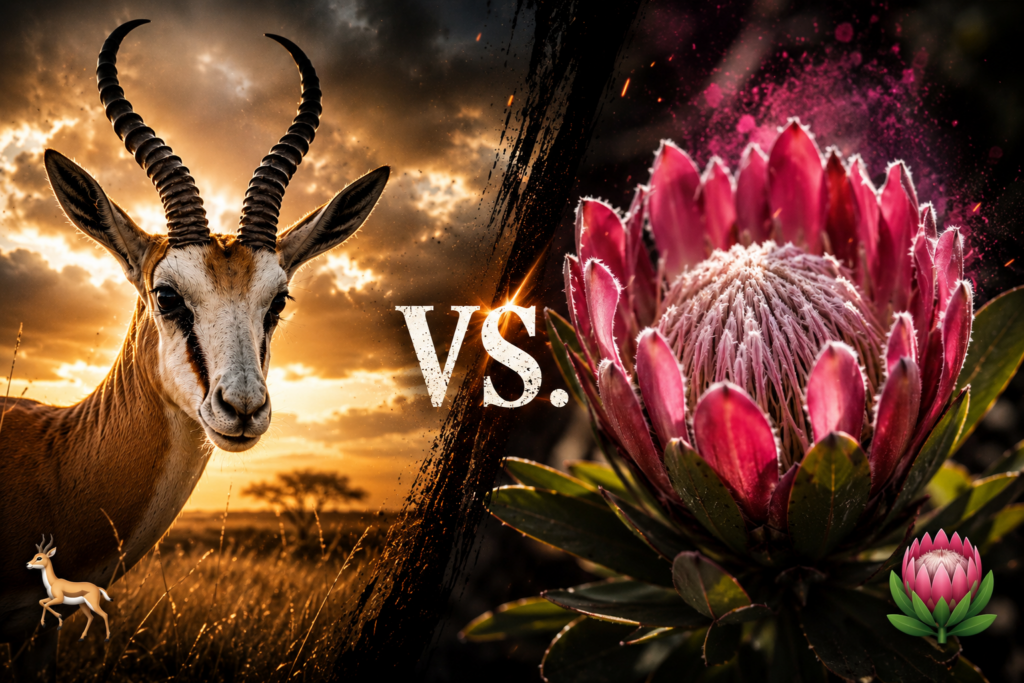
In reality: you don’t have to make a choice. You can have both. Getting one doesn’t mean you can’t get the other. It is not a competition between the two and they are not mutually exclusive – they are approved (or not) on their own merits. Frankly, it’s quite difficult for any emoji to be approved due to the very large emoji set already encoded and the impracticality of adding more en masse. There is no rivalry between Springboks and Proteas 🤗: one day they could both find their place on the world’s keyboards.
As the figures look right now, you are just a bit less likely to have a springbok emoji approved by the gatekeepers at the Unicode Consortium. But who knows; if you don’t try for the buck then you won’t get one.
For the moment, at least, you’ll just have to settle for the rugby football emoji: 🏉
As a ‘thought experiment’ for further exploration – below follows a more precise conceptual breakdown of possible arguments for either emoji:
🦌 The Case for a Springbok Emoji
The strongest argument for the Springbok would be to frame the springbok as a globally recognisable animal concept that happens to have unusually strong cultural associations, rather than as a South African national symbol. Since there is already and antelope emoji this is a special-case argument – but this is how you might litigate it:
1. It is an unmistakable and visually distinctive animal
This is probably one of the springbok’s strongest advantages.
The springbok has a combination of features that can survive reduction to the tiny size required of an emoji:
- distinctive long, swept horns
- a recognizable body shape (but don’t assume that people outside of South Africa will)
- contrasting dark-and-white facial markings
- the characteristic white rump
- a recognisable jumping posture (as seen on rugby team emblems)
Unicode specifically asks whether an emoji is recognisable at approximately 18×18 pixels, and whether it represents a visually distinctive entity rather than merely a generic member of a broad category.
A well-designed springbok could therefore potentially pass the distinctiveness test.
And importantly, this is not simply “another antelope.” The visual identity of a springbok is unusually compelling.
2. It represents something that the current animal emoji set doesn’t represent well
This is potentially the biggest conceptual argument.
Unicode already has 🦌 deer, 🦬 bison, 🐃 water buffalo, 🐏 ram, 🐐 goat, 🐂 ox, 🐪 camel, 🦙 llama, etc.
But there is no emoji representing an African antelope specifically.
The argument shouldn’t be:
“There are lots of antelope species, so Unicode needs them all.”
That would run directly into Unicode’s warning against creating overly specific taxonomic distinctions.
Instead:
“The springbok is an iconic representative of African antelope and African wildlife generally, in the same way that existing animal emoji can represent broader concepts beyond a single biological species.”
That is a much stronger argument. That gives it considerably more utility than merely “emoji for one species.”
Unicode explicitly says that emoji are intended as paradigms, rather than precise scientific classifications.
3. It has substantial metaphorical meaning
This is another area where the springbok has an unusually good story.
Unicode gives additional weight to emoji that have multiple meanings, metaphors or symbolism. Their example is a shark 🦈, which can represent the animal but also a predatory person, a “loan shark,” etc.
The springbok has several established associations:
- Speed
- Agility
- Leaping
- Grace
- Freedom
- The African landscape
- South Africa
- Sport
- Strength and resilience
And then there is the particularly powerful cultural association with South African identity, through the national rugby team.
That means:
🦌 = deer
🦘 = kangaroo
🦓 = zebra
🦁 = lion
🦌/springbok = African plains, South Africa, speed, rugby, wildlife
The proposal would need to demonstrate actual usage of these concepts rather than merely asserting them, but conceptually this is an inclusion argument.
4. It has unusually strong global cultural recognition
This is where the South African connection becomes useful – but not as a conservation argument.
The springbok is not merely an obscure African animal known primarily to zoologists.
It has become an internationally recognizable symbol through:
- South African sport
- international rugby
- wildlife tourism
- nature documentaries
- African wildlife imagery
- South African culture and history
The important distinction is:
“South Africans want a springbok emoji” is weak Unicode evidence.
Whereas:
“The word and image ‘springbok’ have substantial international usage across wildlife, sport, geography, culture and literature”
…is precisely the sort of proposition that can be tested through Unicode’s required frequency methodology.
Unicode requires evidence from Google Search, Google Video Search, Google Trends Web Search, Google Trends Image Search and Google Books Ngram Viewer. It specifically rejects petitions and anecdotal claims as evidence.
5. It works well in emoji combinations
Unicode specifically asks whether a proposed emoji can be used with other emoji to communicate additional concepts.
The springbok has lots of potential.
African wildlife
🦌 + 🦁 + 🐘
South Africa
🦌 + 🇿🇦
South African rugby
🦌 + 🏉
wildlife conservation
🦌 + 🌿
African savanna
🦌 + 🌾 + ☀️
speed
🦌 + 💨
jumping/leaping
🦌 + ⬆️
nature tourism
🦌 + 📷
And there is an especially interesting cultural combination:
Springboks vs Proteas
🦌 🆚 🌸
That last one is obviously more culturally specific, but it illustrates something useful: a springbok emoji could become a building block, rather than simply an illustration.
6. It could represent a broad geographic and ecological concept
This is important because Unicode is wary of overly narrow emoji.
The proposal could argue that the springbok isn’t merely a species identifier. It is an icon of southern African grassland and savanna ecosystems.
That gives it associations with:
- Africa
- southern Africa
- grasslands
- drylands
- wildlife
- migration
- grazing ecosystems
- biodiversity
- nature tourism
This is considerably broader than something like proposing an emoji for an obscure subspecies.
7. It has permanence rather than being a passing trend
The springbok isn’t dependent on a current meme, celebrity or temporary cultural phenomenon.
Its significance predates modern social media by centuries and exists simultaneously in:
- zoology
- African history
- geography
- literature
- tourism
- sport
- popular culture
That gives it a strong argument against Unicode’s transient exclusion factor.
But here are the problems – and they’re serious
This is where I think we need to be brutally honest if we’re going to build a credible proposal.
❌ 1. “It’s South Africa’s national animal” isn’t enough
Probably the biggest trap.
Unicode explicitly says:
Do not justify the addition of an emoji because it furthers a “cause.”
A proposal based primarily on national pride, conservation or representation would therefore be weak.
So:
“South Africa deserves a springbok emoji.”
…is not our strongest argument.
Instead:
“The springbok is a visually distinctive, globally used animal concept with multiple meanings and strong combinatorial utility that fills a gap in the existing animal emoji repertoire.”
That’s the argument.
❌ 2. “Africa doesn’t have enough animals” is also weak
Unicode does not try to create a zoological catalogue.
Its guidelines specifically say the goal is iconic representation of large categories, not completeness of scientific taxonomy.
So we can’t argue:
- Lion ✔
- Elephant ✔
- Zebra ✔
- Giraffe ✔
- Therefore springbok? ✔
That’s essentially an argument for endless species additions.
We need to establish why springbok is an iconic category-level concept, rather than simply another species.
❌ 3. Deer could already represent it
This is probably the most obvious exclusion argument.
Unicode explicitly considers whether a proposed concept is already representable by another emoji, even when the existing emoji isn’t an exact match (as noted above).
Someone could simply use:
🦌 = antelope / deer / hoofed animal
And Unicode could reasonably ask:
Why isn’t that sufficient?
This is a hurdle we would need to answer convincingly.
The answer would have to rest on semantic and visual distinction, not biological taxonomy.
We would have to try to argue that a springbok is not merely “a deer-like animal.” It conveys a specific and recognizable concept: springbok / African antelope / southern African wildlife.
❌ 4. It could be considered overly specific
This may be the single biggest vulnerability.
Unicode specifically asks whether an emoji is overly specific, and cautions against proposals that simply create increasingly narrow distinctions within a category.
There are hundreds of antelope species.
Why springbok?
Why not:
- kudu?
- gemsbok?
- impala?
- wildebeest?
- eland?
If we can’t establish that springbok has a significantly broader cultural and semantic footprint than those species, the proposal becomes vulnerable.
This is why “iconic African antelope” is a much more useful framing than “one particular species of antelope.”
❌ 5. The global usage evidence could be the killer
This is the part we can’t simply write our way around.
Unicode’s high-usage criterion is empirical. They want actual numbers from the specified search sources.
And they don’t just want:
“Springbok is famous.”
They want measurable evidence.
This is where we’d have to do serious work.
The interesting question isn’t:
“Is springbok popular?”
It’s:
How does “springbok” perform in Unicode’s required search tests compared with existing animal emoji and previous successful proposals?
If the numbers are weak internationally (compared to minimum baselines), that could kill the proposal regardless of how compelling the cultural argument is.
❌ 6. The rugby association could actually cloud the data
This is a fascinating problem.
“Springbok” generates enormous amounts of sport-related material.
But Unicode could ask:
Is this evidence for the animal or evidence for the rugby team?
We’d therefore need to separate the animal concept from the sporting concept in the frequency analysis.
Ironically, one of the springbok’s greatest cultural strengths could also make the search data messy and harder to interpret.
❌ 7. It doesn’t complete an obvious fixed category
Unicode gives particular weight to proposals that complete established sets – zodiac signs, card suits, blood types, etc.
A springbok doesn’t obviously do that.
There’s no fixed:
African mammals emoji set
with one obvious missing member.
So completeness is probably a weak or neutral factor.
We shouldn’t try to manufacture an argument here.
❌ 8. Compatibility is probably irrelevant
Unless we can demonstrate that a major existing platform already uses a springbok emoji or equivalent high-frequency symbol, the compatibility criterion won’t help us.
Unicode specifically requires evidence of high-frequency use in the existing system for compatibility to count positively.
So again: probably N/A, rather than something we should stretch.
Preliminary Springbok verdict
If we were scoring the proposal strategically:
| Unicode factor | Springbok case |
| Multiple concepts | 🟢 Strong |
| Sequences | 🟢 Strong |
| Breaks new ground | 🟢/🟡 Potentially strong |
| Distinctiveness | 🟢 Strong |
| Usage | 🟡 Needs hard evidence |
| Completeness | 🔴 Weak |
| Compatibility | 🔴 Probably irrelevant |
| Already represented | 🟡 Major challenge |
| Overly specific | 🟡 Major challenge |
| Open-ended | 🟡 Needs careful argument |
| Transient | 🟢 Very strong |
| Justified by existing emoji | 🟡 Deer is the obvious counterargument |
So one wouldn’t build the case around conservation, South African pride, or even rugby.
We’d build it around this:
The springbok is an unusually recognisable and visually distinctive African animal whose cultural meaning extends well beyond its biological classification. It represents an iconic African antelope, southern African wildlife and landscape, speed and agility, and – through established cultural usage – South Africa. Unlike a generic deer, its visual form and semantic associations are sufficiently distinct to function as a unique emoji building block.
And then the make-or-break section would be the empirical frequency evidence.
The protea is, in some ways, an even more interesting Unicode case than the springbok – but it has some different vulnerabilities.
🌸 The case for a Protea Emoji
1. It is exceptionally visually distinctive
This is probably the protea’s strongest argument.
A protea has a highly unusual visual structure:
- large crown-like flower head
- overlapping bracts
- long central florets
- distinctive shape and texture
- strong silhouette that remains recognisable even when simplified
That matters enormously for emoji.
Unicode begins by asking whether a proposed emoji is distinctive and recognisable at small sizes. A protea has a much stronger visual identity than a generic “flower.”
And crucially, it isn’t simply just another flower (it’s actually a community of flowers, within a flower).
A simplified protea can potentially be recognised from its overall shape alone.
2. The existing flower emoji do not adequately represent it
This is probably the central argument.
Unicode already has 🌹 rose, 🌷 tulip, 🌻 sunflower, 🌺 hibiscus, lotus, 🌸 cherry blossom, 💮 white flower, hyacinth, and others.
So Unicode could reasonably ask:
Why do we need another flower?
The answer is that the protea is visually and culturally distinct enough to represent a different concept.
A 🌹 is not a protea.
A 🌺 is not a protea.
A 🌻 is not a protea.
And unlike many proposed individual flowers, the protea has a very distinctive morphology that can be communicated through an emoji.
The proposal therefore shouldn’t argue:
“There are lots of flowers, but we’re missing one.”
It should argue:
The existing flower emoji repertoire lacks a representative of the distinctive protea flower form and the botanical/cultural concepts associated with it.
That’s considerably stronger.
3. It could represent an entire botanical family, not merely one species
This is where the protea becomes particularly interesting.
The proposal wouldn’t necessarily have to position the emoji as:
“an emoji for Protea cynaroides.”
That would immediately invite the overly specific objection.
Instead, the emoji could represent the broader protea/proteaceae concept.
The Proteaceae family contains hundreds of species across several genera and is particularly associated with the Southern Hemisphere and the Cape Floristic Kingdom.
That gives the concept considerably more breadth.
And Unicode’s emoji philosophy is about representing recognisable concepts rather than creating a complete scientific taxonomy.
4. It has strong geographic and cultural meaning
This is where the king protea has a particularly strong case.
The protea is strongly associated with South Africa and is the country’s national flower.
But, just as with the springbok, we should not make:
“South Africa deserves a flower emoji.”
…the primary argument.
That is essentially a national-pride argument, and Unicode’s guidelines make clear that a cause or cultural campaign isn’t sufficient justification.
Instead, South Africa should be one component of a much larger argument.
The protea has established associations with:
- South Africa
- the Cape Floristic Region
- fynbos
- botanical diversity
- wildflowers
- resilience
- fire-adapted ecosystems
- horticulture
- floristry
- gardens
- biodiversity
That is a much richer semantic footprint than simply a “national flower.”
5. It has extraordinary ecological symbolism
This is a particularly useful secondary argument.
Proteas are strongly associated with fire-adapted ecosystems, especially in the Western Cape.
Their ecology provides a remarkable set of concepts that could be communicated through combinations:
🌸🔥 = fire-adapted flowering plant
🌸🌿 = indigenous flora
🌸🇿🇦 = South African flora
🌸🏔️ = mountain/fynbos landscape
🌸🐝 = pollination
🌸🦋 = biodiversity/pollinators
🌸🌱 = native plants
🌸🔥🌱 = regeneration after fire
That makes the protea potentially useful beyond simply naming the flower.
And this is exactly the kind of combinatorial utility that strengthens an emoji proposal.
6. It has unusually strong symbolic associations
A protea has acquired meanings far beyond botany.
It is associated with:
- Strength
- Transformation
- Resilience
- Diversity
- Courage
- Beauty
- South Africa
- renewal
Some of these meanings arise from cultural symbolism and some from the plant’s biology.
The important thing is that the proposal would need to demonstrate actual established usage, rather than simply assigning meanings to the flower after the fact.
But conceptually, this gives the protea considerable potential for embodying multiple-concepts.
7. It represents biodiversity particularly well
This could be a useful argument, but it should remain secondary.
The protea is associated with the exceptionally diverse Cape Floristic Region and with one of the world’s major biodiversity hotspots.
That gives it a useful symbolic role:
A protea emoji could function as a visual shorthand for fynbos, indigenous flora, botanical diversity and the extraordinary plant diversity of southern Africa.
That is more compelling than simply saying:
“We need a conservation emoji.”
Because Unicode is very unlikely to accept an emoji primarily because it advances a conservation cause.
8. It has international horticultural and floral significance
This is important because we don’t want the proposal to look like a purely South African campaign.
Proteas are cultivated and traded internationally as ornamental and cut flowers.
They appear in:
- floristry
- bouquets
- weddings
- gardens
- botanical collections
- horticultural publications
- floral design
- photography
That gives the concept an international life independent of South African nationalism.
This could be particularly valuable for the frequency criterion.
9. It is permanent rather than transient
This is straightforward.
The protea isn’t a meme, fad, celebrity, product or temporary cultural phenomenon.
It is a biological organism with:
- millions of years of evolution
- centuries of botanical documentation
- established common names
- horticultural importance
- cultural symbolism
- geographic significance
So the transient exclusion criterion should present little difficulty.
Now the problems:
❌ 1. “It’s South Africa’s national flower” isn’t enough
Exactly the same problem as with the springbok.
This is useful supporting evidence, but it can’t be the central justification.
Unicode isn’t a collection of national symbols.
If the argument is:
🇿🇦 South Africa has a national flower → therefore South Africa deserves an emoji
…that’s weak.
If the argument is:
The protea is a globally recognisable botanical concept with distinctive visual characteristics, established international horticultural use, multiple meanings and strong combinatorial potential, with its South African identity adding further semantic utility
That’s much stronger.
❌ 2. “We don’t have a South African flower” is not enough
Again, this would be a category-completeness argument that doesn’t really work.
Unicode isn’t trying to give every country its national flower.
Otherwise we’d need hundreds.
So we must establish why protea itself is an iconic concept.
❌ 3. There are already some flower emoji
This is probably the biggest vulnerability.
Unicode could reasonably say:
🌸 🌺 🌻 🌷 🌹 – there are already plenty of flowers.
Why does the world need another?
This means the proposal has to make a very strong case for visual and semantic distinctiveness.
Fortunately, the protea has a better answer to that question than many flowers would.
A protea isn’t merely a different colour of an existing flower.
Its morphology is fundamentally different.
❌ 4. It could be considered too specific
This is the protea’s equivalent of the springbok problem.
There are many protea species.
And then there are many other genera within Proteaceae.
Unicode could ask:
Why protea rather than waratah, banksia, grevillea, hakea, etc.?
If the proposal says:
“We want an emoji for Protea cynaroides.”
…we’ve made the problem worse.
We should strongly favour treating the emoji concept as “protea” broadly, rather than arguing for a specific species that we happen to favour.
❌ 5. The existing 🌺 flower emoji may be considered sufficient
This is another important challenge.
Unicode doesn’t require every flower to have its own emoji.
The proposal therefore has to answer:
What can a protea communicate that 🌺 cannot?
The answer needs to be concrete, and we would need to demonstrate those through actual usage evidence.
❌ 6. Its global frequency may be the biggest obstacle
This is where things get serious.
Unicode requires quantitative evidence using its prescribed sources, including:
- Google Search
- Google Video Search
- Google Trends
- Google Books Ngram
The protea would need to demonstrate sufficient frequency relative to other emoji candidates.
And there’s a complication here.
“Protea” is a relatively specific botanical word.
The common-language usage may be substantially lower than terms like:
- Rose
- Sunflower
- Tulip
- orchid
Outside of Southern Africa, Proteas as a flower are not that well known. That could make the numerical case difficult.
❌ 7. “Protea” has some linguistic ambiguity
There is another interesting issue.
“Protea” can refer to:
- the genus
- individual species
- the family in broader popular usage
- the national flower
- floral products
- botanical concepts
This isn’t necessarily fatal, but the proposal would need to define the emoji concept very carefully.
The intended visual would probably need to be unmistakably a protea rather than a generic flower.
❌ 8. Conservation arguments could actually hurt the case
This is worth emphasising.
We could very easily create a wonderful and emotional conservation story:
- Proteas are threatened by habitat loss.
- Fynbos is under pressure.
- Biodiversity is declining.
- Therefore: we need a protea emoji to raise awareness.
It’s a fantastic public campaign for proteas (which the Wild Rescue nature reserve has already been doing 🥰).
But it isn’t necessarily a great Unicode argument.
Unicode explicitly warns against proposals based on causes.
So conservation should be used to demonstrate semantic relevance, not as the reason Unicode should approve it.
Preliminary Protea verdict
| Unicode factor | Protea case |
| Multiple concepts | 🟢 Strong |
| Sequences | 🟢 Strong |
| Breaks new ground | 🟢 Potentially strong |
| Distinctiveness | 🟢 Very strong |
| Usage | 🟡 Needs evidence |
| Completeness | 🟡 Challenging |
| Compatibility | 🔴 Probably irrelevant |
| Already represented | 🟡 Challenging |
| Overly specific | 🟡 Challenging |
| Open-ended | 🟡 Needs careful framing |
| Transient | 🟢 Very strong |
| Existing emoji sufficient? | 🟡 Main argument to overcome |
And here’s where it gets really interesting
If we’re genuinely building two Unicode proposals, one wouldn’t make the springbok and protea cases identical.
One would position them as complementary but independently defensible concepts:
🦌 Springbok
The iconic African animal
Its case rests heavily on:
animal distinctiveness + African representation + South African cultural meaning + speed/agility + sport + wildlife
🌸 Protea
The iconic Southern African flower
Its case rests heavily on:
visual distinctiveness + botanical identity + South African flora + biodiversity + resilience + horticulture + fynbos
And there’s a potentially powerful overarching argument:
The current emoji vocabulary has strong representation of iconic African fauna, but almost no representation of the distinctive flora of southern Africa.
But – and this is important – one shouldn’t submit them as a package deal.
Unicode evaluates proposals individually. The protea and the springbok must be able to stand on their own – as with all other emoji.
The question that could decide both cases is the same: What do the actual Unicode-required frequency tests show? (and are the current metrics for this enough?)
That’s the point where this stops being an interesting argument and becomes a potentially serious proposal.
If the current Wild Rescue proposal for a protea emoji fails, and whether attempts are made for a springbok emoji: South Africa just needs to stand together and keep trying. 💪🇿🇦 Keep building better cases and, vitally – keep searching, learning, sharing, posting and promoting globally around these concepts until there is sufficient awareness and usage frequency.
Submissions for new emoji proposals will re-open in 2027.