

South Africa hosts 13 species of tortoises – including Stigmochelys pardalis the Leopard Tortoise – which is more than anywhere else in the world.
Common Tortoise Species in the Western Cape
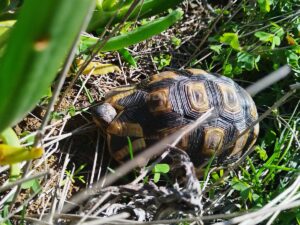
- Angulate Tortoise (Chersina angulata): Easily recognized by the reddish-brown coloring on its belly and the prominent “plowshare” scale extending under its neck. They are abundant in coastal fynbos and dunes. This is the tortoise most often seen on Wild Rescue Nature Reserve, and the one most often hurt on roads, and in towns in our area. A medium-sized tortoise.
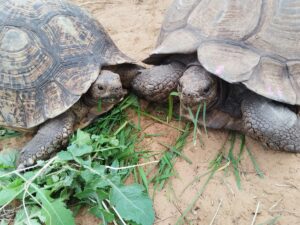
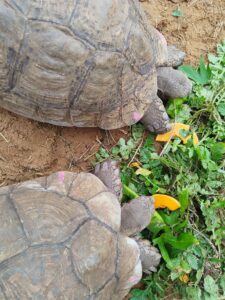
- Leopard Tortoise (Stigmochelys pardalis): The largest species in South Africa. And 4th largest tortoise in the world. The largest is the Galapagos tortoise then the Aldabra tortoises (Seychelles), and the African Spurred Tortoise found just south of the Sahara. Leopard tortoises are beautifully marked with black and yellow spots resembling a leopard’s coat, and they thrive in both arid and grassland habitats. Leopard tortoises do not occur naturally in our region, however several individual members are free-roaming, probably from being let out or escaping from being kept in captivity by people who keep tortoises for pets. Wild Rescue has 29 leopard tortoises in our tortoise sanctuary – rescued from farm workers, or confiscated by CapeNature from owners who picked them up and took them home (without a permit).
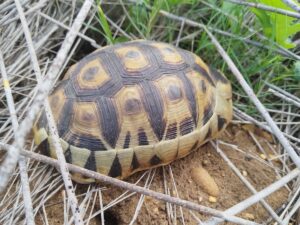
- Tent Tortoise (Psammobates tentorius): Known for the distinct, peaked “tent” shapes on their shell segments, with color patterns varying highly depending on whether you find the Karoo (rare), Namaqua, or Bushmanland Tent tortoise.
- Speckled Padloper (Homopus areolatus): Also known as the Parrot Beaked tortoise. As the world’s smallest tortoise, it rarely exceeds 10cm in length. They are highly elusive and blend perfectly into the rocky, scrub-covered terrain of the Overberg and surrounding areas. Also Karoo Padloper; Common Padloper and Greater Padloper (variations but different species)
Endangered tortoise species in the Western Cape
Geometric tortoise (Psammobates geometricus) is a critically endangered species of tortoise. It is found in a very small section in the South-Western Cape – in the low-lying renosterveld shrublands of the Swartland, Upper Breede River Valley and Ceres Valley – where most land has been taken over by wheat agriculture , wine farming and urban development.
More about Tortoises in South Africa
Tortoises are reptiles (like snakes) but have 4 limbs which are strong, and although reported to be slow, they can walk far, and are relatively fast when motivated to feed or find a mate. Tortoises also have toenails (numbers vary depending on species). These give them added traction for walking. (Sea turtles have webbing between their toes for swimming)
They are very capable diggers, especially for laying their eggs. The legs have to carry a lot of weight around (especially the larger species) and are armoured and very muscular. An important defense mechanism is pulling their legs into their shell, (it is virtually impossible to pull a leg out once in) – one of evolution’s ways of defending themselves and enabling tortoises to survive millenia.
Every tortoise has a unique shell pattern like the human fingerprint. Each segment of shell is called a scute – made from keratin (similar to human fingernails). Unique markings on some tortoise shells may come from abuse by humans, for example, some have recovered broken shells where rocks were thrown at them, and others have holes in the back scute where they were tied up, before being eaten or sold.
Tortoises do not have teeth, but a very horny beak which is very strong, and can eat relatively thorny succulents such as prickly-pear leaves, and aloes, Tortoises make a hissing sound when disturbed (much like a snake). Adult tortoises’ weights range widely, depending on the species. Our leopard tortoises range from 5 kgs to 30 kgs depending on their age and individual genes.
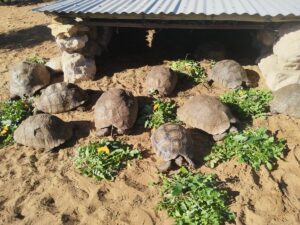
Larger species of tortoise generally live longer (up to 150 years) than the smaller species (+-50 years). Wild Rescue NPC has a female tortoise named “Ouma” (‘Grandma’) who we estimate to be 68 years old. Females grow faster and bigger than males. Males have a concave under shell (to assist in mating) and females are generally flat underneath. Most species of tortoises cannot swim, apart from the leopard tortoise, whose domed shell has a sizable lung capacity that allows for buoyancy.
Tortoises can drink (absorb water) through their cloaca (an opening serving for removal of waste, and for mating). This is a useful aid when dealing with a dehydrated tortoise, as he/she can absorb water and certain minerals and medication through the cloaca in order to rehydrate. This soaking also assists with clearing out of toxins and aids the digestive system. Tortoises can go without water for long periods, providing food is available, however do need to drink regularly, and can enjoy bathing in shallow water to cool off. The greatest threat to the species is humans, who not only take their land, but trade in them, sell them or eat them.
During the summer months they are active when food is optimal, so that they can build up their food reserves for the long, dry winter. Our tortoises eat half the amount in winter compared to summer, and if it is raining and cold we do not feed them at all as they tend to hibernate.
Tortoises are important seed dispersers in the wild as they eat large quantities of plants and their faeces (or scats) are full of undamaged seeds. Tortoises are not territorial, and are usually loners apart from mating season. The male tortoise is not a gentle lover, but butts the female into submission.
Large females lay several clutches, and depending on the temperature, incubation may take 8-15 months. Females are formed at high temperatures (31 – 34°C), whereas males hatch from eggs incubated at lower temperatures.
How to Help or Rescue a Tortoise
Tortoises move across territories, especially looking for a mate, and have no “road” sense. If you see a tortoise in the middle of the road – if possible stop before the tortoise and allow it to cross over safely. If it is a very busy road, pull over safely and you can gently lift the tortoise under the shell and place it on the side to which it was heading. Do everything gently and slowly as they urinate as a protection tool, and this may result in them becoming dehydrated, and possible death.
Do not take them away from the area, and do not keep tortoises as a pet – whilst it may seem kind it is actually a thoughtless and selfish act.
Although not all species of tortoise are considered as “threatened” at this stage, if poaching is not controlled they may become threatened in the near future.
Tortoise Regulations and Protections
- Illegal to Collect from the Wild: You cannot pick up a tortoise from the bush or road and take it home. Removing them from their environment is a criminal offense that can result in heavy fines or imprisonment.
- Permit Requirements: If you legally acquire a tortoise (e.g., from a registered breeder), you must have a Captivity Permit from your provincial authority. A permit is also required to legally transport or sell the animal.
- Roadside Rescues: If you see a tortoise crossing a quiet road, you can gently lift it (keeping it parallel to the ground) and place it on the side of the road in the direction it was heading. Do not remove it from the area.
- The SPCA Mandate: The National Council of SPCAs strongly enforces the fact that conservation and animal welfare are intertwined. They actively penalize those keeping tortoises without adequate living space or legitimate documentation.
If you are currently dealing with a specific situation, such as a tortoise that wandered into your garden, or are you looking for information on how to apply for a legitimate captive-bred permit, please contact your closest tortoise rehabilitation centre, vet, or provincial conservation authority.
Tortoise Myths
Some people keep tortoises as pets in South Africa, with the belief that the tortoise chained to your house will keep evil spirits away such as the folkloric “Tokoloshe.” Another myth is that if a tortoise is kept in a chicken pen that it will increase the yield of your eggs – but chickens are sensitive to high ammonia – sanitation is the larger issue.
Tortoise Rehabilitation and Rescue
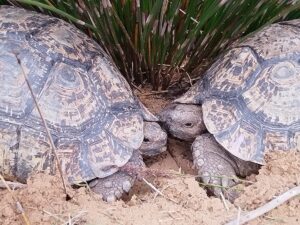
Tortoises require serious rehabilitation after being seized, as they usually have not had proper food for months and are severely dehydrated
They cannot simply be released. The tortoises need to be properly housed for a few months, monitored, hydrated and given plenty of the correct high-fibre foods. The gut bacteria must be restored, and deworming and flushing through must occur.
If tortoises are released without proper rehabilitation, pathogens can be released into the wild, and negatively affect healthy wider tortoise populations.